


Environmental monitoring at the Ducal Palace in Urbino: the preventive conservation project
A cultural heritage to be protected
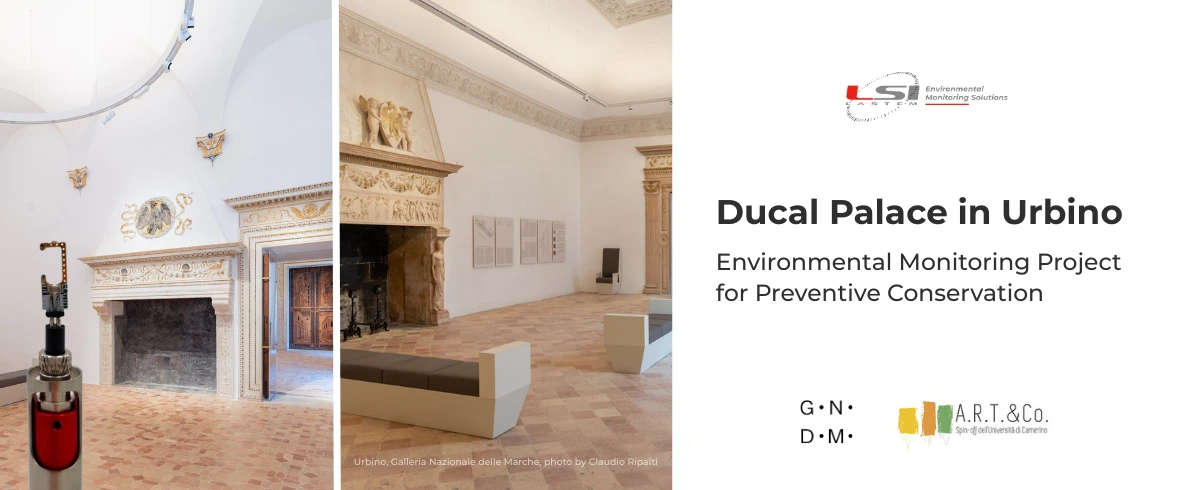
The Ducal Palace of Urbino, home to the National Gallery of the Marche, houses unique masterpieces of the history of Italian art. Securing these spaces and the artworks on display is a complex challenge: being a historical building, traditional air conditioning systems cannot be implemented. Thanks to the funds from the PNRR – Recovery Fund, a project for the improvement, adaptation, and energy efficiency of the exhibition spaces has been initiated, integrating an innovative microclimatic environmental monitoring system. The project is not yet complete but is already operational and constantly evolving, combining technology, research and the protection of cultural heritage.
Conservation partners and technologies
The project involves cultural institutions and several scientific partners. LSI LASTEM provided the hot wire anemometers, essential for measuring air velocity at critical points within the Palace. These are complemented by sensors from other partners dedicated to monitoring other environmental variables. A. R. T. & Co., a spin-off of the University of Camerino, supported this initial phase with diagnostics and validation activities, laying the foundation for continued support in subsequent phases. Completing the project is the National Gallery of the Marche, which, along with the other institutions involved, ensures strategic coordination, integrating technological, scientific and cultural expertise for shared and sustainable project management.
Data analysis and use
In the next phases of the project, the data collected by the sensors will be transmitted to a centralized platform, analyzed, and will allow to:
- Identify microclimatic trends and anomalies;
- Generate periodic reports useful for preventive management;
- Support potential scientific publications and the dissemination of results internationally.
Objectives and aims of the microclimate monitoring project
The primary objective of the project is to create a stable microclimate control infrastructure capable of:
- Constantly monitoring temperature, humidity, air velocity, and environmental quality;
- Preventing risk situations for artworks, especially the most delicate ones such as panel paintings;
- Improving climate comfort for visitors without altering the architectural structure;
- Providing reliable data for targeted conservation and restoration decisions.
Monitoring is currently active in the rooms on the Piano Nobile, with the goal of completing coverage of the other rooms on the second floor by May 2026.
Timeline and development phases
To date, the project is approximately 60% complete. It is expected to reach 85% by the end of the year, with final completion scheduled for May 2026. During this period, interim reviews and data presentations are planned, useful for evaluating the system’s effectiveness and sharing initial results.
Impact and future prospects
The project represents a replicable model for other historic buildings and museums in Italy, where heritage protection needs must coexist with architectural and structural constraints. For the National Gallery of the Marche, it means having an innovative system to sustainably preserve its works and offer an optimal visitor experience.
Conclusion
With the environmental monitoring project at the Ducal Palace of Urbino, LSI LASTEM confirms its role as a strategic partner in the preventive conservation of cultural heritage. A concrete example of how the integration of technology and research can provide effective and measurable solutions for the protection and enhancement of cultural heritage.
