


40 Years at LSI LASTEM, the experience of Alfredo Astori, Director of the Technical Office
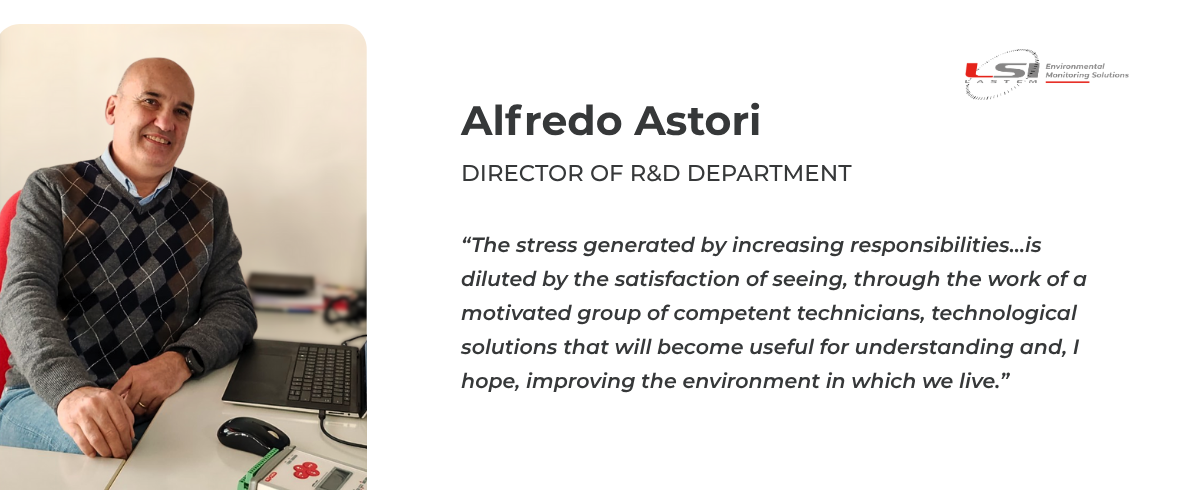
Forty years in a company are not just a number: they are experiences, people, challenges and major changes lived firsthand.
Alfredo Astori joined LSI LASTEM in 1985, when environmental measurement was done with analog instruments and the concept of “digital” was still in its early days. Today, after four decades, he leads the Technical Department and continues to be a point of reference for his expertise, vision, and passion for innovation.
In this interview, he tells us about his journey, the evolution of technology over time, and his vision for the future of environmental measurement — with that curious and practical spirit that has always characterized LSI LASTEM.
1. Alfredo, this year you're celebrating 40 years at LSI LASTEM! Would you like to tell us how your journey with the company began and what inspired you to embark on this adventure?
My background comes from electronics, between analog and digital circuits. In the ’80s, while I was still studying, microelectronics and the first 8-bit microprocessors were revolutionizing the world: computers were beginning to enter the homes of enthusiasts. With a solid foundation in digital circuits, moving to microprocessors was natural — in fact, a real leap. I soon found myself exploring those fascinating and mysterious machines, trying to understand their language and master them with the first commands.
At my school, the microprocessor courses were still experimental, so much of my experience came from personal experiments and long evenings programming in Basic, Z80 Assembly, and Motorola 68000. When I reached the Industrial Instrumentation Laboratories, I was enthusiastic and curious: there I saw professional instruments dedicated to environmental measurements for the first time and immediately realized that it was the place for me.
At LASTEM, then a branch of LSI, I started getting hands-on experience with digital circuits, memories, and the first IBM PCs. I went from Basic to Pascal and then to PLM/80, the language that accompanied me for years, until the arrival of new technologies that marked the beginning of a continuous evolution. That’s when I realized that in this profession, you never really stop.
I still remember those days: printed listings on continuous feed paper, green monitors with flickering text, long waits to compile a program twice a day. It was a slow world, but incredibly alive. With the arrival of the IBM PC, everything changed: work became faster, paving the way for progress that has never stopped since — a journey that continues to amaze me, just like back then, with the same passion.
2. Over these forty years, you've seen LSI LASTEM grow and change profoundly. What, in your opinion, are the moments or projects that have most shaped your career?
Already at the end of the 1980s, at LSI LASTEM we understood that innovating also meant changing the way we design. We moved from the drafting table to 2D CAD, adopting software developed by a truly cutting-edge company from Bologna. That program, entirely Italian, opened up new possibilities for us: greater flexibility, productivity, and a more modern mindset. Since then, the drive for innovation has never stopped. Today, we work in 3D, not only for the mechanical part but also for the electronic part and we use 3D printers for prototyping.
With the arrival of the Internet in the mid-1990s, everything changed. We began experimenting with new communication systems between our instruments and the computers that collected environmental data. We moved from old dial-up connections to the Internet and mobile telephony with GPRS: it was a small revolution, because suddenly data could travel in real time, anywhere in the world.
In 1999, our first wireless sensors also arrived. Eliminating cables was a breakthrough, especially in museums and art installations, where every detail counts. Since then, radio technology has evolved, culminating in the use of LoRaWAN, which today allows us to have reliable, long-distance connections.
Another important milestone came in 2014, when we decided to adopt Linux for our embedded systems. This choice gave us enormous flexibility. Years earlier, I had preferred Windows CE, due to internal expertise issues, but over time I’ve realized that the most sound decisions are those that look ahead, not just those that are most convenient in the short term.
In recent years, we’ve also chosen to focus more on our core business—design and innovation—by outsourcing the production of some parts to external partners. It’s a complex challenge, but it allows us to focus our energies on what really matters: continuing to innovate, while maintaining the skills and knowledge that make us unique in-house.
3. You've been the Director of the Technical Office for several years. What do you do on a daily basis, and what are the main challenges you face in your role?
At LSI LASTEM, we design comprehensive, high-quality solutions that combine diverse technologies into a single, harmonious system. Our goal is to offer flexible and competitive products that can adapt to a wide range of markets and applications. To do this, we strive to reuse and adapt the same technological foundations in diverse contexts, maintaining consistency and sustainability in development.
Behind all this lies complex teamwork: technicians with vertical expertise in physics, mechanics, electronics, embedded and cloud programming, data management, and technical and commercial documentation. As a technical director, I find myself involved in all these areas—sometimes directly, other times relying on the expertise of my team—with the goal of maintaining balance and collaboration, key elements for achieving truly solid results.
Curiosity, technological research and a touch of perfectionism are what drive me every day. I encourage technicians to look beyond the simplest solutions, to pay attention to details, and to choose with foresight. I firmly believe in finding the right balance between technical expertise and responsible decision-making: that’s where quality comes from, the quality that makes the difference in our products.
4. Guardando al futuro, quali evoluzioni immagini per il settore della misura e del monitoraggio ambientale? Cosa pensi cambierà nel modo di lavorare di aziende come LSI LASTEM?
In recent years, artificial intelligence has emerged from the lab and entered everyday life. Its diffusion has been rapid and profound, representing one of the greatest technological leaps of our time. At LSI LASTEM, we cannot ignore this revolution: today, AI supports our work in many ways, and we are still discovering its full potential.
In the field of environmental monitoring, I see constant progress: increasingly precise, miniaturized, and efficient sensors thanks to microelectronics and new materials. Artificial intelligence plays a decisive role here too, accelerating the discovery and design of innovative materials that enable increasingly high-performance sensors. It is a continuous evolution, and we are constantly seeking solutions that maintain the high level of quality and technology of our instruments.
But with the increase in connected devices, the challenge of cybersecurity also grows. Regulatory bodies are working to create shared standards, but system vulnerability remains a sensitive issue. That’s why we constantly invest time and resources to ensure our solutions remain reliable and secure, without sacrificing the benefits that connectivity and innovation offer us.
5. After so many years, what still motivates you every day? What gives you the most satisfaction in your work and in the team you lead?
Working alongside young engineers, but also with colleagues who are no longer young, is an opportunity that gives a profound sense of fulfilment in one’s life. The stress generated by increasing responsibilities, deadlines and technical difficulties is diluted by the satisfaction of seeing a motivated group of skilled technicians create technological solutions that will be useful for understanding and, I hope, improving the environment in which we live. All this has an ethical and moral value that further strengthens my motivation in everything I do every day.
6. If you had to give advice to a young engineer starting at a company today, what would it be?
If I were to give advice to anyone considering a career path, of any kind, it would be best given as early as the moment they choose their university major. I believe this choice should be made by seeking to uncover deep within oneself the specific subject or future profession that will spark intense curiosity and interest, thus sparking the willpower to learn, understand, and create one’s own professional future. Those who are fortunate enough—and I would also say wise enough—to have understood the importance of this choice and put it into practice with the right commitment during their studies will certainly find themselves in the right position, once they enter the workforce, to confidently face the challenges that lie ahead. That initial interest, now turned into a profession, if properly cultivated, will sustain them in the professional struggles of the years to come.
I wouldn’t have much in terms of advice to give that young engineer, except to keep that interest alive by staying curious about everything related to his profession, certainly continuing to further develop his knowledge and creating, with depth of thought, dedication, sacrifice, but also enjoyment, harmonious and useful solutions for the company he works for.