


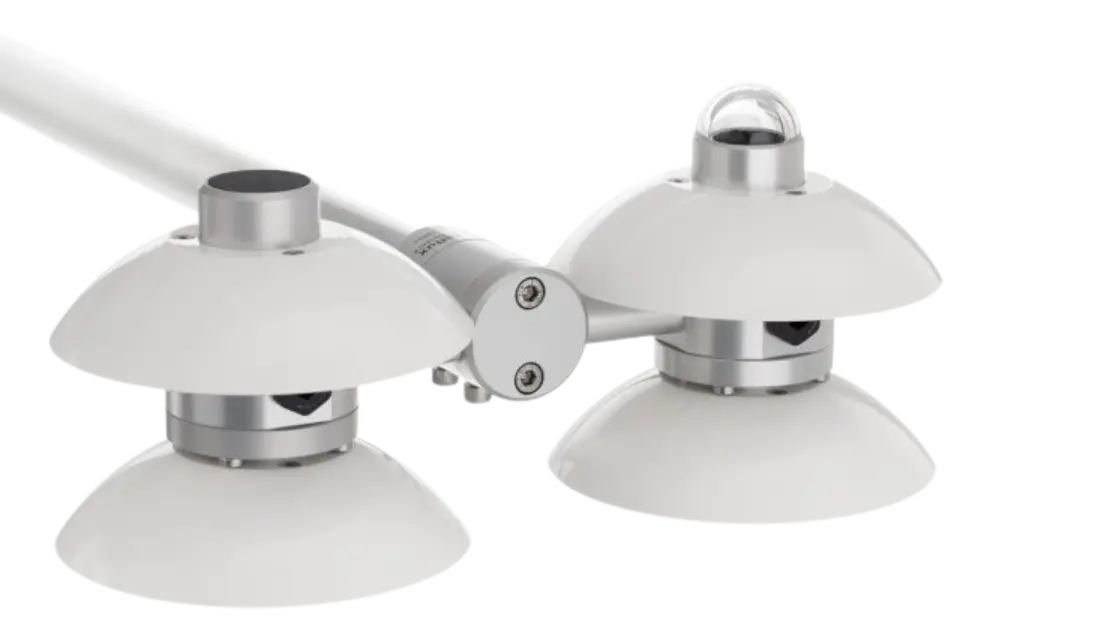

Net solar radiation
High sensitivity thermopile technology
Sensor for measuring net solar radiation: the difference between the incident radiation from the sun and the atmosphere and the component reflected (short wave) and re-emitted (long wave) from the ground.
DATA SHEETS
Description
Description
High sensitivity thermopile technology
Sensor for measuring net solar radiation: the difference between the incident radiation from the sun and the atmosphere and the component reflected (short wave) and re-emitted (long wave) from the ground.
The sensor consists of two surfaces to be positioned parallel to the ground: the upper one measures the incoming solar radiation made up of direct and diffused radiation, the lower surface instead measures the radiation reflected and emitted from the ground. The difference between these two values is the measure of net radiation, which on clear days is positive during the day and negative during the night.
The instrument is designed and built to be used even in extreme weather conditions.
Highlights
- Measurement of the net radiation between that coming from the sky and that coming from the ground (reflected and emitted) in the 0.3÷50 μm band;
- Based on thermopile technology that ensures a fast response time and a substantial insensitivity to wind speed, which is the major problem of sensors based on other technologies such as “black bodies”;
- Versions with μV output and 4÷20 mA output;
- Accessories for obtaining RS485-Modbus RTU output from the DPA240 model;
- Model codes: DPA840 / PRRDA0130, DPA240 / PRRDA0100A, DPA266.
FAQ: Frequently Asked Questions
What is net radiation, and why is it important to measure it?
Net radiation is the difference between the radiant energy received from the sky and the energy reflected or re-emitted by the Earth’s surface. It represents the energy actually available to heat the air and soil, melt snow, and drive evaporation and evapotranspiration, making it essential for studying surface energy and water balances.
How does an LSI LASTEM net radiometer work?
The sensor uses two surfaces positioned parallel to the ground: the upper surface measures incoming radiation from the Sun and the atmosphere, while the lower surface measures the radiation reflected and emitted by the ground. The difference between the two signals gives net radiation, which is generally positive during the day and negative on clear nights. Thermopile technology covers the 0.3 to 50 µm spectral range and is only slightly affected by wind speed.
In which meteorological, climatological, and environmental applications is net radiation used?
Net radiation is used in weather stations and climate networks to analyse energy exchanges between the atmosphere and the surface. In agrometeorology, it is a key parameter in the FAO Penman-Monteith method for calculating evapotranspiration; in research, it supports studies on climate, ecosystems, vegetation, albedo, land use, and hydrological balance. It can also help interpret atmospheric dispersion processes and local environmental conditions.
Which configurations does LSI LASTEM offer for net radiation measurement?
The range includes net radiometers that measure the overall radiation balance across the 0.3 to 50 µm range, with direct µV or 4–20 mA outputs and RS485 Modbus integration options. A four-component net radiometer is also available, measuring incoming and outgoing shortwave radiation and incoming and outgoing longwave radiation separately, for scientific applications requiring a more detailed analysis of the radiation balance.
Additional information
Additional information
| Applications | Agro-meteorology, Air quality, Meteo observations, Waste cycle |
|---|---|
| Grandezze |
Product
DPA840/PRRDA0130-DPA240/PRRDA0100A
Categories Meteo sensors, Sensors, Solar radiation
High sensitivity thermopile technology
Sensor for measuring net solar radiation: the difference between the incident radiation from the sun and the atmosphere and the component reflected (short wave) and re-emitted (long wave) from the ground.
The sensor consists of two surfaces to be positioned parallel to the ground: the upper one measures the incoming solar radiation made up of direct and diffused radiation, the lower surface instead measures the radiation reflected and emitted from the ground. The difference between these two values is the measure of net radiation, which on clear days is positive during the day and negative during the night.
The instrument is designed and built to be used even in extreme weather conditions.
Highlights
- Measurement of the net radiation between that coming from the sky and that coming from the ground (reflected and emitted) in the 0.3÷50 μm band;
- Based on thermopile technology that ensures a fast response time and a substantial insensitivity to wind speed, which is the major problem of sensors based on other technologies such as “black bodies”;
- Versions with μV output and 4÷20 mA output;
- Accessories for obtaining RS485-Modbus RTU output from the DPA240 model;
- Model codes: DPA840 / PRRDA0130, DPA240 / PRRDA0100A, DPA266.
FAQ: Frequently Asked Questions
What is net radiation, and why is it important to measure it?
Net radiation is the difference between the radiant energy received from the sky and the energy reflected or re-emitted by the Earth’s surface. It represents the energy actually available to heat the air and soil, melt snow, and drive evaporation and evapotranspiration, making it essential for studying surface energy and water balances.
How does an LSI LASTEM net radiometer work?
The sensor uses two surfaces positioned parallel to the ground: the upper surface measures incoming radiation from the Sun and the atmosphere, while the lower surface measures the radiation reflected and emitted by the ground. The difference between the two signals gives net radiation, which is generally positive during the day and negative on clear nights. Thermopile technology covers the 0.3 to 50 µm spectral range and is only slightly affected by wind speed.
In which meteorological, climatological, and environmental applications is net radiation used?
Net radiation is used in weather stations and climate networks to analyse energy exchanges between the atmosphere and the surface. In agrometeorology, it is a key parameter in the FAO Penman-Monteith method for calculating evapotranspiration; in research, it supports studies on climate, ecosystems, vegetation, albedo, land use, and hydrological balance. It can also help interpret atmospheric dispersion processes and local environmental conditions.
Which configurations does LSI LASTEM offer for net radiation measurement?
The range includes net radiometers that measure the overall radiation balance across the 0.3 to 50 µm range, with direct µV or 4–20 mA outputs and RS485 Modbus integration options. A four-component net radiometer is also available, measuring incoming and outgoing shortwave radiation and incoming and outgoing longwave radiation separately, for scientific applications requiring a more detailed analysis of the radiation balance.


