


Microclimate monitoring in the workplace: traditional station or Heat Shield?
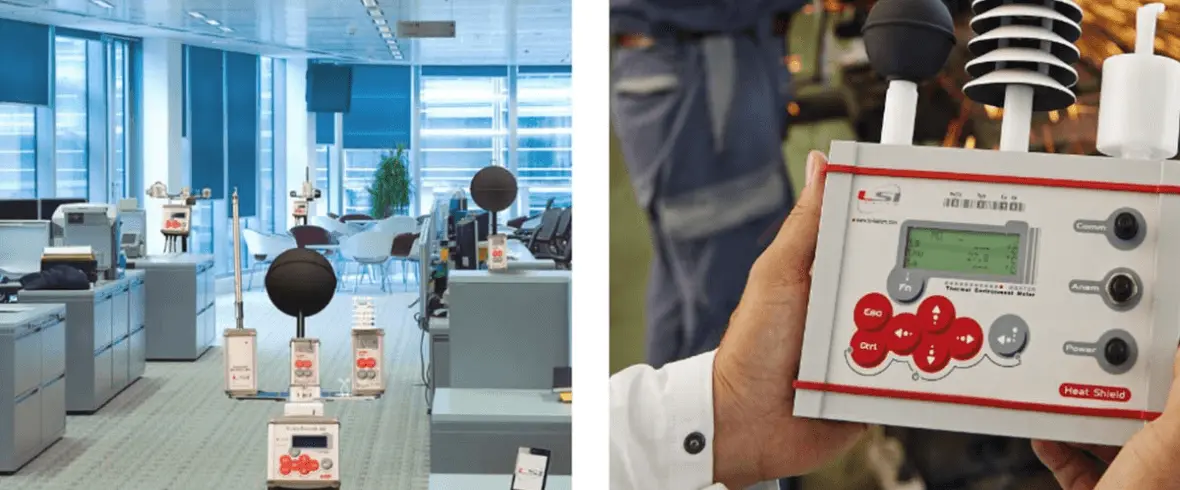
LSI LASTEM offers different solutions for the thermal evaluation of work environments, whether they are moderate or severe (hot/cold), and guides its customers in the most suitable choice according to the microclimatic indexes that they wish to be analysed, in accordance with the UNI EN ISO 7726:2002 standard.
The importance of the microclimate
The term microclimate refers to the set of physical parameters, including temperature, relative humidity and air speed that, together with individual parameters such as the type of work carried out, the metabolic activity and the thermal resistance of clothing, affect the heat exchange between the individual and the environment, in a confined space. It is known that exposure to inadequate microclimatic conditions can cause more or less serious consequences both on the health and on the working capacity of an individual.
That’s why many national labour legislations recognise the microclimate as a physical risk agent and each employer has the obligation to assess all possible risks to its workers’ health in order to identify and adopt the appropriate prevention and protection measures with particular reference to the standards of good technique and good practice. These include regular monitoring of the microclimate, using specific tools.
Microclimatic station or ready-to-use integrated system? Microclimatic stations for multiparameter monitoring
LSI LASTEM microclimate stations are flexible and versatile solutions, most suitable where a full multiparameter correlation is required. The system consists of a data logger and a higher number of sensors, selected according to the application: thermal comfort (PMV-PPD), thermal stress (WBGT, PHS) or cold (IREQ). In detail, some indices (WBGT, Operating Temperature and localised discomfort) are analysed directly by the data logger while others, which require complex calculations, are determined in post-processing thanks to the Gidas TEA (Thermal Environments Application) software suite. In addition, through air quality and illuminance sensors it is possible to acquire additional quantities for an integrated measurement system, which includes the analysis of IEQ (Indoor Environmental Quality).
The advantages of Heat Shield
Heat Shield is the easy-to-use compact system with integrated LSI LASTEM sensors. It is particularly suitable where the calculation and real-time display of the WBGT index is required for the purposes of assessing the risk from thermal stress in environments of severe heat, according to UNI EN ISO 7243:2017 and the PMV-PPD comfort index in moderate environments, pursuant to the UNI EN ISO 7730:2006 standard.
The installation of Heat Shield takes a few minutes and can be hand-carried for a short-term monitoring campaign. In addition, thanks to the built-in radio technology, the instrument can support up to two satellite units for analysis at different levels or in multiple positions. Finally, the collected data can be downloaded and stored, for evaluation and reporting, through the included HS Manager PC programme.
FAQ: Frequently Asked Questions
Is measuring temperature alone enough to assess workplace microclimate?
No. Temperature alone is not enough to properly assess workplace microclimate. Technical standards require considering relative humidity, air velocity, mean radiant temperature, metabolic rate, and clothing, because thermal comfort or heat stress depends on the combination of these factors. For this reason, microclimatic indices such as PMV and PPD in moderate environments, and WBGT in hot environments, are often more meaningful than temperature alone.
Is a portable instrument or a fixed system better for workplace microclimate monitoring?
It depends on the purpose of the measurement and the application context. A portable instrument is more suitable for site inspections, spot checks, temporary surveys, and technical measurements in different areas of the workplace. A fixed system with a datalogger is more appropriate when continuous monitoring, historical data recording, and constant calculation of microclimatic indices are needed, providing stronger support for technical assessments, risk management, and documentation.
Which parameters and indices should be considered in workplace microclimate monitoring?
The key parameters are air temperature, relative humidity, air velocity, and mean radiant temperature. However, in technical assessments, the most useful information is often provided by the microclimatic indices calculated from these measurements. In moderate environments, the main reference is PMV-PPD according to UNI EN ISO 7730, while in severe hot environments WBGT is very important according to UNI EN ISO 7243. UNI EN ISO 7726 is instead the main reference for instrument quality and measurement methods.
When should you choose a fixed microclimate monitoring system?
A fixed system is the most suitable choice when microclimatic conditions vary over time, when environmental trends need to be documented, or when continuous data are required for index calculation. Its main strength is not only the continuous measurement of temperature, but above all the ability to assess thermal comfort and heat stress over time in a more complete way and in line with technical criteria.
What are the strengths of LSI LASTEM solutions for workplace microclimate monitoring?
LSI LASTEM solutions make it possible to choose the most suitable approach depending on the situation: portable instruments for spot measurements and datalogger-based systems for continuous monitoring. Their main strength is the ability to support a more complete microclimate assessment, focused on indices rather than temperature alone, with solutions suitable for technical surveys, periodic checks, historical analysis, and applications aligned with the main regulatory references.