


Interview on the importance of wind monitoring in ports
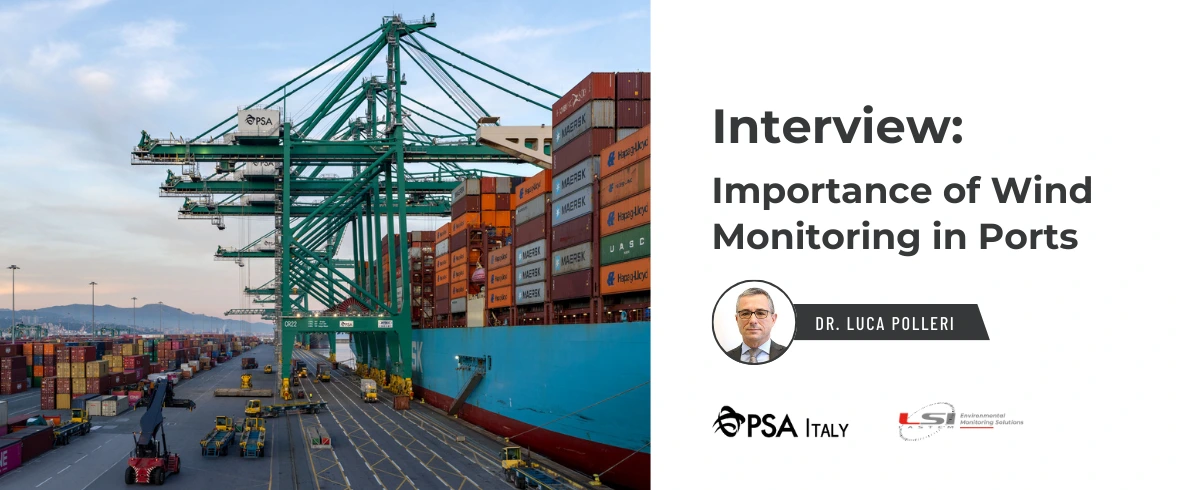
Luca Polleri, Head of Engineering at PSA Genova Pra'
Luca Polleri is Head of Engineering at PSA Genova Pra’, a role he has held since 2021. With over 30 years of experience in the engineering and maintenance sector, he has built his career within complex industrial companies, developing solid expertise in the technical management of port infrastructure and lifting equipment.
He joined the PSA Group in 2005 and spent over 15 years in key roles in plant maintenance supervision and technical planning, first as Port Equipment Maintenance Planning Supervisor and subsequently as Equipment Engineering Supervisor.
Before joining the port sector, Luca gained extensive experience in industrial automation, working for Nidec Conversion as an R&D Industrial Automation Platform Technician, after holding the position of Engineering and Commissioning Technician at Ansaldo Movimentazione.
1. Can you describe your role within PSA Genova Pra'? What do you do?
In my role as Head of Engineering at a container terminal like PSA Genova Pra’, the largest import/export terminal in Italy, I’m responsible for ensuring that all technical infrastructure functions safely and efficiently, through the maintenance and management of port equipment, which is the operational heart of the terminal, from the quayside cranes to container handling equipment such as reach stackers or RMGs, and even the electrical systems. The team of technicians and engineers in the Engineering department where I work is highly trained: we plan preventative maintenance and intervene in the event of critical issues that could impact operations. Ours is a strategic job, requiring vision and a focus on safety: it’s not just about responding when something breaks, but about constantly innovating to meet the needs of every aspect of the terminal, from quayside operations to sales colleagues, through the adoption of new technologies, supplier management, and technical investments.
My daily goal is to find solutions that make activities simpler, safer, and more sustainable, and doing this in a complex and ever-evolving environment like that of a container terminal requires experience, flexibility and a great deal of passion.
2. What are the key environmental parameters to monitor in the port environment? How are they related to the safety of operations and workers?
The most critical environmental variables are wind speed and direction, followed by precipitation, temperature, visibility, and, of course, sea and weather conditions. Wind, in particular, has a direct impact on the use of quay cranes and yard operations. Once a certain wind threshold is exceeded, certain operations are progressively limited or suspended: with an initial wind threshold, all operations involving empty containers, which present greater aerodynamic resistance, are halted; the access gate for empty containers is blocked, meaning no vehicles transporting them can enter; trucks carrying empty containers that entered before the weather event are unloaded and secured, and then allowed to exit. At that point, no further operations are performed on empty containers. If the wind intensifies further, operations involving full containers are also halted, and the terminal is completely closed. This is an essential preventative measure for staff safety: above certain wind values, in fact, all our colleagues in the yard and on the quayside cranes are evacuated and gather in the «wind room».
3. How is the wind monitoring system you implemented structured, how does it work, and how is it used?
Our quay, railway and yard cranes are equipped with anemometers to detect wind speed for intrinsic protection. Some of these, carefully selected, interface remotely with the data acquisition system, the same system used by the sensors installed on the lighting towers. Data is acquired in real time and sent to a control platform, accessible to both yard managers and operations supervisors. The system issues automatic alarms at various threshold levels, indicating when operations need to be reduced or suspended. The information is also historically recorded for post-event analysis.
4. A comment on LSI LASTEM equipment and the company's services?
Our collaboration with LSI LASTEM has been consolidated for years and has represented a significant step forward in weather monitoring: the equipment provided, particularly the professional anemometers, has proven reliable even in extreme conditions.
A key strength is undoubtedly the software integration, which allows for the entire system management and automatic, reliable reporting. Furthermore, our partnership with LSI LASTEM allows us to rely on regular maintenance and technical support to ensure efficient operation and peak performance, maximizing technical planning and safety.