
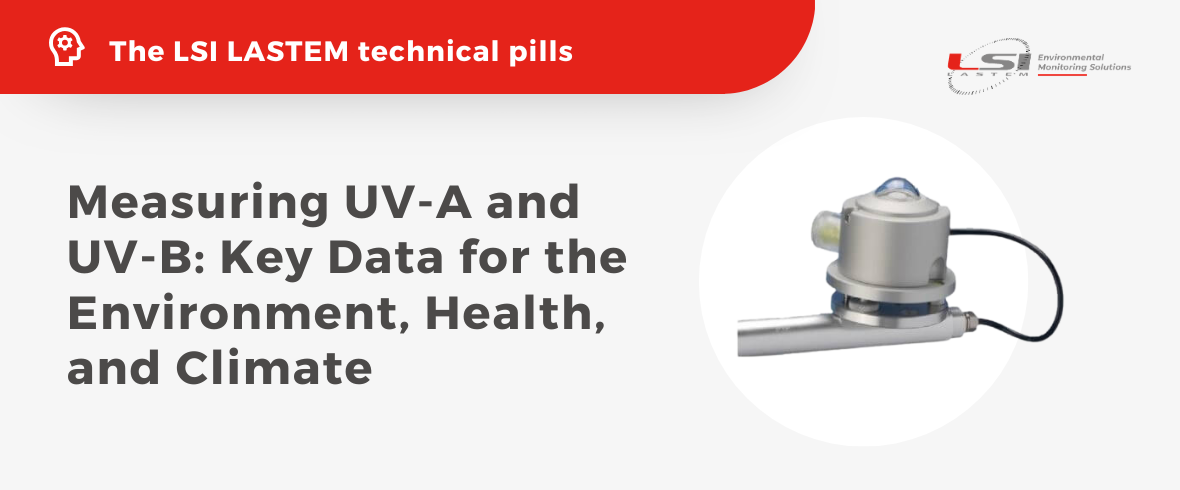
Measuring UV-A and UV-B: Key Data for the Environment, Health, and Climate

Measuring UV-A and UV-B: Key Data for the Environment, Health, and Climate

UV-A and UV-B sensors are advanced devices in the field of solar radiation monitoring. These broadband radiometers are designed to measure atmospheric irradiance in the UV-A and UV-B spectrum, according to WMO standard n.8 chap.7.

In this technical pill dive, we explore the distinctive features of these broadband radiometers and their impact in meteorological applications. First, however, it is essential to understand the crucial role these measures play in the current climate change landscape and how these dynamics affect the environment and people.

UV-A, UV-B, and Climate Change

In the debate on climate change, attention often focuses on temperature, extreme weather events, and air quality, while ultraviolet radiation takes a back seat. Yet monitoring UV-A and UV-B is essential to understanding how environmental conditions affecting ground-level exposure are changing: it is not only the intensity of solar radiation that matters, but also the role of stratospheric ozone, cloud cover, atmospheric aerosols, altitude, and surface reflectance. In this context, measuring UV-A and UV-B separately provides concrete data to observe a complex and time-varying phenomenon with direct impacts on human health, ecosystems, and outdoor activities. For this reason, today more than ever, UV monitoring is not a secondary parameter but an essential tool for understanding the effects of climate change in a more comprehensive and informed manner.

One point worth noting is that climate change can influence UV-A and UV-B levels in an indirect yet significant way by affecting the atmospheric and surface factors that regulate their transmission to the ground. Variations in cloud cover, for example, can attenuate or, under certain conditions, locally amplify incident radiation; similarly, changes in the concentration of aerosols, dust, and particulate matter alter the scattering and absorption of ultraviolet radiation in the atmosphere. Another crucial factor is the state of stratospheric ozone, which acts as a filter, particularly against UV-B, making this wavelength band especially sensitive to its variations. Climate-related changes in land surfaces, such as the reduction of snow cover or ice and thus of ground reflectance, can also alter the total amount of UV received locally. For this reason, in the current climate context, monitoring UV-A and UV-B means observing not only the radiation itself, but also the combined effects of the atmosphere, weather, and changes in the Earth’s surface.

UV Monitoring for Climate Studies

For climate studies, the monitoring of UV-A and UV-B radiation is of particular scientific interest because it provides observational data on the interactions between solar radiation, atmospheric composition, and the radiative properties of the Earth’s surface. Ultraviolet radiation at the surface is in fact modulated by variables such as columnar ozone content, cloud cover, aerosol load, and surface albedo, all factors that directly or indirectly influence the radiative processes of the climate system. The availability of continuous, traceable, and metrologically reliable time series therefore allows for the analysis of UV radiation variability on seasonal and interannual scales, the identification of anomalies associated with specific atmospheric conditions, and the provision of datasets useful for the validation of radiative and atmospheric models. In this sense, the measurement of UV-A and UV-B is not only a descriptive parameter of ground-level exposure but also a significant observational tool for studying the processes linking atmospheric dynamics, chemical composition, and climate change.

Public Health Effects and Prevention

From a public health perspective, monitoring UV-A and UV-B radiation is particularly important because these two components of ultraviolet radiation have direct and cumulative effects on the human body. Excessive exposure to UV rays is associated with acute skin damage, such as erythema, and more serious chronic effects, including premature skin aging, skin cancers, eye damage such as cataracts, and alterations to the immune system. UV-B rays are primarily responsible for erythematous reactions and a significant portion of the most immediate biological damage, while UV-A rays, which constitute the majority of UV radiation reaching the ground, contribute significantly to photoaging and cumulative damage over time. Monitoring both parameters therefore provides concrete and useful information not only for environmental research but also for prevention, risk communication, and the protection of people, particularly the most vulnerable individuals and those who work or engage in outdoor activities.

High-Precision Measurement Solutions

To address these environmental and health challenges, it is necessary to rely on instrumentation that guarantees not only ruggedness but also superior metrological accuracy. The ability to translate complex atmospheric phenomena into reliable datasets depends directly on the design choices of the radiometer. Precisely to meet these requirements for excellence, LSI LASTEM sensors are designed to operate in the most demanding outdoor conditions.

Sensitive element and cosine response

The sensing element of these sensors is a photodiode with optical filter and interferential deposition, which not only improves spectral transmission, but is also designed to ensure optimal cosine response. The addition of a high-quality glass dome and a Teflon diffuser further contributes to improving the precision of the irradiance measurement, especially at low angles of incidence.

Wide spectral response for outdoor measurements

One of the distinctive features of LSI LASTEM UV-A and UV-B sensors is their broadband spectral response. Thanks to this feature, they are able to cover the entire UV-A and UV-B spectrum, making them ideal for outdoor measurements, where the main source of radiation is the sun. This distinguishes them from other sensors on the market, which are often optimized to detect radiation from artificial sources in indoor environments.

Technical characteristics of UV-A and UV-B radiometers

  • Good adherence to typical UV-A and UV-B radiation curves;
  • Calibration performed outdoors for better response to sunlight and atmospheric conditions;
  • Traceability at the ARPA Ivrea center (Italy) ISO17025;
  • Excellent cosine response;
  • Sensors with broadband spectral response;
  • Technology with thin metal film filter and silicon photodiode suitable for UV measurements;
  • In accordance with WMO Analog output 4…20 mA and power supply 10…30 VAC/DC.

Accuracy and calibration

The uncertainty of the instantaneous reading is defined through the calibration of a reference sensor performed by ARPA of Ivrea. This procedure allows you to precisely calculate the daily uncertainty, obtained by integrating the radiation throughout the day. For the UV-A sensor, this uncertainty is 12%, while for UV-B it is 15%. The evaluation of the uncertainty linked to the angular response is good, remaining within ±8%, in line with the rigorous WMO standards (which require a value lower than 10% for incidence angles lower than 60°).

In addition to the documented uncertainty, a distinctive aspect of these sensors is the calibration performed in real solar conditions, comparing the results with those obtained from the reference sensors calibrated at ARPA in Ivrea. This process, which can span from one to several days, is an essential strength in validating and optimizing the performance of UV-A and UV-B sensors.

Use for estimating UV Index and UVI Index

Although UV-A and UV-B radiometers are not specifically designed for the measurement of erythemal spectral irradiance, the measurement of the two ultraviolet components allows an estimate of the UV Index with an error within 22%.

The UV Index is determined using an empirical formula derived from that defined by the World Health Organization, which has been carefully calibrated using data provided by the JRC (Joint Research Centre) of ISPRA, a European reference point for UV measurements. ultraviolet. This formula is then integrated into the LSI LASTEM data loggers. Additionally, the Universal UV Radiation Index (UVI) provides an assessment of the level of solar ultraviolet radiation reaching the Earth’s surface in a specific geographic area. With values ​​ranging from zero to 11, the index indicates the increasing potential damage to skin and eyes caused by sun exposure.

The creation of this index is the result of a collaboration between various organizations and commissions, with the aim of raising public awareness of the risks associated with sun exposure.

Conclusion

LSI LASTEM’s UV-A and UV-B sensors prove to be essential tools for atmospheric monitoring, ensuring precision and reliability in measurements. Their broad spectral response and accuracy in estimating the UV Index place them at the center of advanced solutions for meteorological and environmental applications.

Download the article:

FAQ: Frequently Asked Questions

The UV Index is a scale from 0 to 11+ that indicates the potential damage to skin and eyes in a specific area. It is calculated using an empirical formula (WHO/JRC Ispra) integrated into LSI LASTEM data loggers.

The difference lies in the spectral band they measure. UV-B sensors detect radiation that is highly sensitive to the ozone layer and responsible for sunburns (erythema). UV-A sensors measure the most prevalent radiation reaching the ground, which is the primary cause of premature skin aging.

The key distinction is the broadband spectral response. While many commercial sensors are optimized only for indoor artificial sources, LSI LASTEM models are specifically designed for outdoor measurements, covering the entire UV-A and UV-B solar radiation spectrum.

Yes. The devices are designed according to WMO standard n.8, chap.7. Furthermore, calibration is ISO 17025 traceable at the ARPA center in Ivrea, ensuring metrologically reliable measurements for scientific and meteorological purposes.

Accuracy is guaranteed by the sensing element’s design for an optimal cosine response, supported by a high-quality glass dome and a Teflon diffuser that improves measurements at low angles of incidence.

Contact us for more information
Drag & Drop Files, Choose Files to Upload Puedes subir hasta 6 archivos.
Checkbox