


Security and business continuity: the LSI LASTEM lightning sensor for monitoring storm phenomena
The need for early warning on lightning
Climate change is altering the frequency and intensity of many weather events, making it increasingly essential to promptly observe and interpret what is happening in the environment.
Storm phenomena represent a real risk for many activities. Lightning strikes can endanger people’s lives, compromise critical infrastructures, damage electrical equipment and cause serious operational interruptions. In sectors such as industry, transport, energy, agriculture and public services, timely monitoring of this threat has become essential.
In this context, LSI LASTEM establishes itself as a reference in environmental monitoring solutions, with technologies designed to guarantee safety and business continuity. Among these, the storm front distance sensor stands out, a tool designed to provide early warning of the approach of a storm, helping to prevent damage and protect people and infrastructure.
The heart of storm prevention
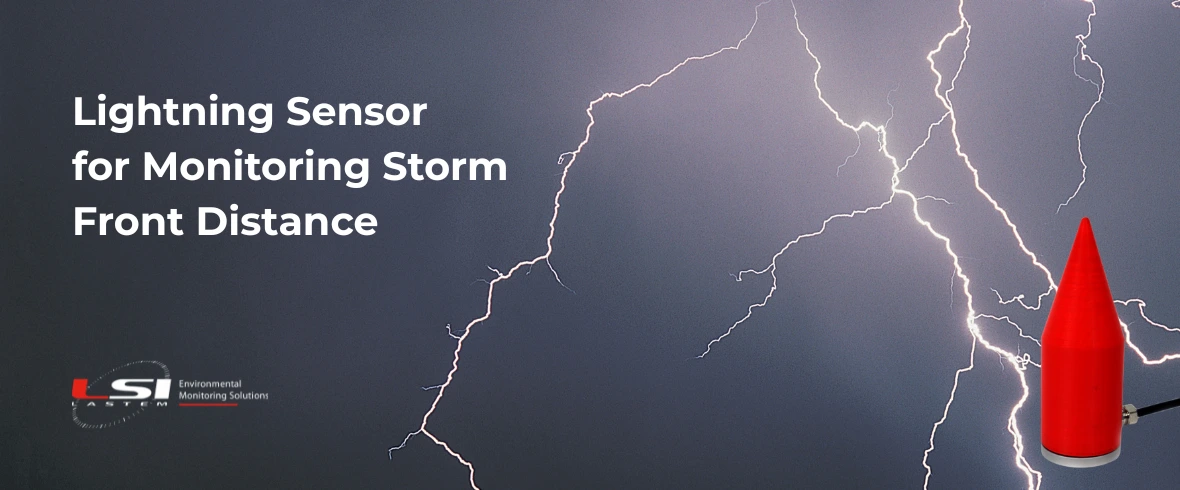
The lightning sensor (models DQA601.1 and DQA601A.3) is an innovative device designed to detect the distance of the storm front thanks to an advanced RF system and an integrated intelligent algorithm.
The sensitive element is able to detect the electromagnetic discharges generated by lightning, both cloud-to-ground and intra-cloud, estimating the distance of the storm front in a radius ranging from 5 km up to 40 km. It is important to underline that the sensor does not measure the strength of the lightning or its direction, but calculates the distance of the storm front, i.e. the area where the most intense electrical activity is concentrated.
Thanks to its compact and robust design, the sensor offers constant and reliable monitoring, even in extreme environmental conditions, contributing to the proactive management of meteorological risk.
Strategic benefits for companies and public entities
The introduction of sensors to detect the approach of a storm front can make the difference between passive risk management and active prevention, based on precise, real-time data.
One of the main benefits is the ability to provide early warning, well before human senses can perceive the danger. This feature allows security managers to take preventive measures in advance, avoiding potentially dangerous situations for people, equipment and structures.
The sensor also protects technological infrastructures, often exposed to damage caused by voltage spikes or interference induced by lightning. The integration of an advanced algorithm allows effective filtering of anthropogenic disturbances, significantly reducing false alarms and increasing system reliability.
Furthermore, the sensor offers programmable detection levels, thus adapting to different contexts: from industrial installations to public structures, from sports facilities to airports.
High technical performance
The lightning sensor has technical specifications that demonstrate its reliability and versatility:
- Detection range: from 5 to 40 km;
- Resolution: up to 15 predefined intervals (e.g. 5, 6, 8, 10, 12, … up to 40 km);
- Operating frequency: approximately 400 KHz;
- Operating temperature: from -40 °C to +85 °C;
- Degree of protection: IP66 (resistant to dust and water jets);
- EMC compatibility: EN 61326-1:2013;
- Low consumption: max 350 µA;
- Power supply: from 5 to 24 V DC;
- Available models: DQA601.1 with RS232 output compatible with Alpha-Log; DQA601A.3 with TTL-UART output, free wires, compatible with Modbus Sensor Box.
These features make it an extremely efficient sensor, suitable for fixed installations in any climatic condition.
Critical applications: protecting every sector
The applications of the sensor for identifying the distance of the storm front are many and transversal. It can be used to increase safety and operational efficiency in important sectors such as:
- Agro-meteorology: to prevent damage to crops and equipment;
- Airports, ports and railways: for timely management of emergencies and logistics;
- Renewable energy: in photovoltaic and wind power plants, to prevent damage due to lightning;
- Hydrology and meteorology: as an integral part of advanced weather stations;
- Public areas and sports facilities: golf courses, swimming pools, parks and schools, to protect visitors in case of critical weather conditions;
- Industry and logistics: to safeguard plants, production processes and operating personnel.
Integration with the LSI LASTEM ecosystem
The sensor, depending on the model, integrates seamlessly with LSI LASTEM systems, such as the Alpha-Log data logger or the MSB module, allowing real-time data collection, analysis and transmission.
Thanks to its compatibility with RS232 and RS485 (Modbus RTU) protocols, the sensor can be easily integrated into existing monitoring infrastructures, with advanced alarm management options via SMS, email, FTP, MQTT and AWS. The supply of installation accessories facilitates its use in any operational context.
A safer future
In a world where extreme weather phenomena are increasingly frequent, equipping oneself with advanced systems for early warning is a strategic and responsible choice. The sensor for measuring the distance of the storm front DQA601X represents a step forward towards a safer, more aware and resilient management of adverse weather conditions.
Download the article:
FAQ: Frequently Asked Questions
What is the LSI LASTEM lightning sensor used for?
The LSI LASTEM lightning sensor is designed to detect the approach of a thunderstorm front and estimate its distance from the installation point. It provides early warning and helps companies, public authorities and infrastructure operators manage thunderstorm-related risks proactively.
Does the sensor measure the exact location of a lightning strike?
No. The sensor does not identify the exact location of a lightning strike, nor does it measure its direction or intensity. Its purpose is to estimate the distance of the thunderstorm front, namely the area where the most significant electrical activity is concentrated.
What is the sensor’s detection range?
The sensor can estimate the distance of a thunderstorm front within a range of 5 to 40 km, using different predefined detection levels. This feature makes it possible to adapt the monitoring system to the operational requirements of the environment in which it is installed.
What types of lightning can it detect?
The sensor detects the electromagnetic discharges generated by both cloud-to-ground and intra-cloud lightning. Thanks to its RF system and integrated algorithm, it can distinguish thunderstorm activity from other electrical interference, reducing the risk of false alarms.
In which sectors can the lightning sensor be used?
The sensor can be used in a wide range of sectors, including industry, logistics, agriculture, energy, airports, ports, railways, sports facilities, public areas and advanced weather stations. It is particularly useful wherever the safety of people and business continuity depend on the ability to respond promptly to severe weather events.
Why is an early thunderstorm warning system important?
An early warning system makes it possible to take action before a risk becomes clearly visible or directly noticeable. This allows exposed activities to be suspended, workers and visitors to be moved to safety, equipment to be protected, and potential damage to infrastructure and production processes to be reduced.