


Environmental monitoring and renewable energy production: the Life Agro-PV project
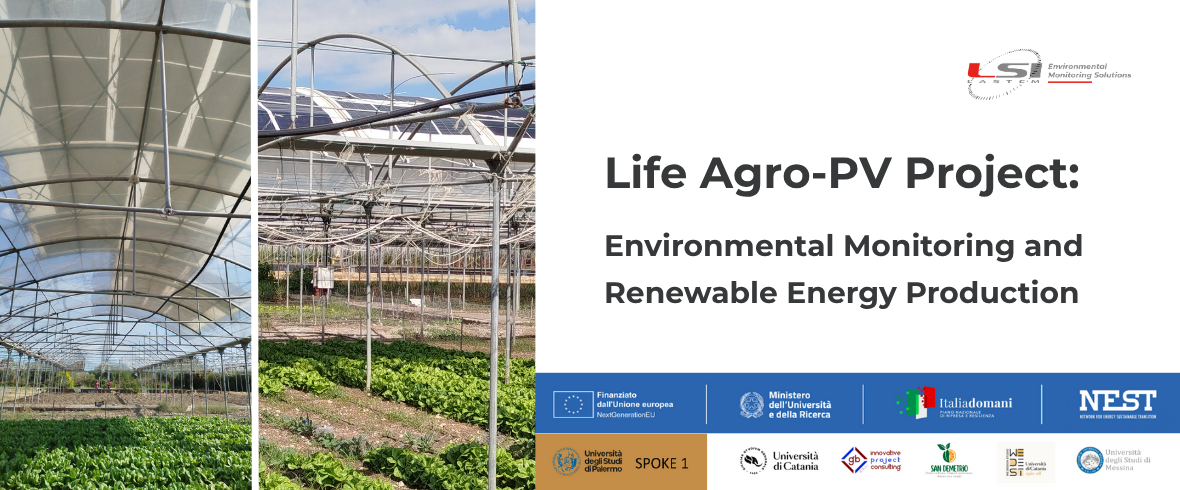
Modern agriculture is increasingly based on precise data and intelligent technologies. Greenhouses are becoming truly connected ecosystems, where environmental monitoring plays a fundamental role in ensuring sustainability, energy efficiency and crop quality.
This is the backdrop for the Life Agro-PV project, funded by the PNRR – NextGenerationEU, which combines two worlds: solar energy and precision agriculture.
In the experimental greenhouses involved, LSI LASTEM’s advanced sensors interact with flexible solar-tracking photovoltaic modules. It’s an intelligent collaboration: the sensors collect data on temperature, humidity, and radiation, while the panels produce energy and regulate shading. Together, they create an integrated system that makes crops more resilient, efficient and sustainable.
The Life Agro-PV Project
The project, coordinated by the University of Catania, takes shape within the framework of a cascade call for proposals of Spoke 1 “Solar: PV, CSP, CST» by the NEST Foundation, coordinated by the University of Palermo, with the mission of developing an innovative and replicable agrivoltaic system.
This initiative brings together scientific research, technology and agriculture: universities, companies and agricultural enterprises collaborate to experiment with new models of integration between energy production and sustainable cultivation. In addition to the University of Catania, through the Departments of Electrical, Electronic and Computer Engineering (DIEEI), Civil Engineering and Architecture (DICAr), and Agriculture, Food and Environment (Di3A), the San Demetrio agricultural company, which hosts the experimental greenhouses, the University of Messina, WEDEST srl, a spin-off of the University of Catania, and the company GB Innovative, which oversaw the implementation, are participating.
Objectives of the Life Agro-PV Project
The Life Agro-PV project aims to integrate next-generation photovoltaic modules into agricultural greenhouses. The goal is twofold:
- Optimize renewable energy production through solar tracking of photovoltaic panels;
- To ensure proper sunlight exposure for the optimal growth of crops, while simultaneously monitoring the main environmental parameters that affect the greenhouse microclimate.
Why monitor the greenhouse environment
In a greenhouse, even a few degrees of temperature difference and insufficient solar radiation can affect the growth, quality and yield of crops. Continuous monitoring of the physical variables of the environment allows for the identification of microclimatic imbalances, optimization of ventilation and irrigation, reduction of waste, and improvement of productivity.
The goal is therefore to transform environmental data into actionable information: knowing the temperature, humidity, radiation, and thermal comfort in real time enables targeted interventions, improving both agronomic performance and energy efficiency.
The LSI LASTEM Monitoring Solution
Three complete LSI LASTEM weather stations were installed for Life Agro-PV, measuring:
- Air temperature and humidity,
- Wind and atmospheric pressure,
- Solar radiation,
- Soil temperature and humidity,
- Temperature of the photovoltaic modules.
All data are collected by LSI LASTEM data loggers and transmitted in real time to the ENVIRO CUBE platform, which allows agronomists and researchers to:
- Access data in real time and remotely,
- Compare greenhouses with and without photovoltaics,
- Set automatic alerts,
- Generate reports and historical analyses.
These tools enable quick data-driven decisions: adjusting panel placement, adapting ventilation, or preventing crop stress.
The microclimate control
In addition to standard meteorological parameters, it is possible to determine the WBGT (Wet Bulb Globe Temperature) index, which combines the thermal effect of temperature, humidity and solar radiation.
Although commonly used to assess human heat stress, in this case it also provides valuable information on the thermal balance of the greenhouse and crops. The WBGT allows us to evaluate worker comfort, ventilation effectiveness, and the impact of microclimatic conditions on plants, helping to refine growth forecasting models.
Challenges and future prospects
During the initial phases of the project, challenges arose related to sensor calibration and the effects of shading. However, initial analyses show promising results: lettuce grown under the panels exhibits lower evaporation and greater water efficiency than those grown in full sun. In the coming months the system may be further enhanced with new sensors (CO₂, vaporization, gas) and integration with automation systems for autonomous microclimate management.
The project, which ended on October 31, 2025, represents a decisive step towards the large-scale replicability of sustainable agricultural models.
A model for the sustainable agriculture of the future
Environmental monitoring in greenhouses demonstrates how innovation in photovoltaics, advanced sensors and data analysis can coexist for more efficient, conscious and resource-friendly agriculture. Thanks to projects like Life Agro-PV, the future of greenhouses will be increasingly intelligent, connected and sustainable.