


Globothermometer: sensor for analysing thermal environments
Climate change and the increasing frequency and intensity of summer heatwaves make the monitoring of thermal environments increasingly important. Summers are becoming hotter, and the assessment of heat stress no longer concerns only indoor environments or occupational health and safety, but also plays a central role in urban spaces, public areas, and all contexts where people may be exposed to critical climate conditions.
For this reason, having reliable instruments to measure microclimatic parameters is essential both in indoor environments, such as offices, factories, and workplaces, and in outdoor environments, such as cities, parks, stadiums, sports facilities, and public areas.
The key role of the globethermometer
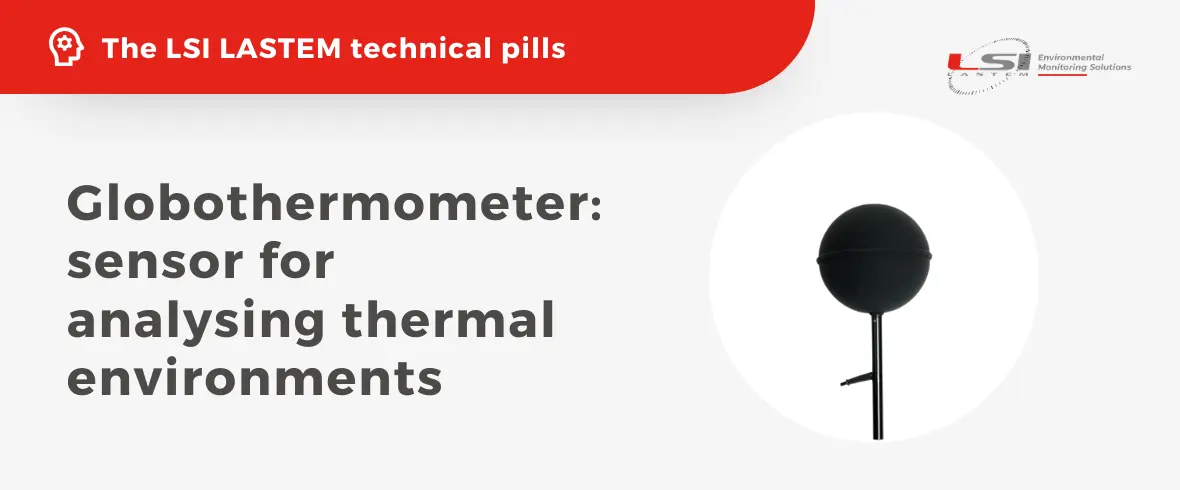
The globethermometer is a fundamental sensor for measuring the temperature of the black globe, a necessary parameter for estimating the mean radiant temperature (Tmrt). Average Radiant Temperature is the net amount of radiant heat lost or received by the human body that corresponds to the algebraic sum of all radiant fluxes exchanged by its exposed parts with the various surrounding heat sources. The latter therefore represents a measure of primary importance in the control of the human energy balance. The Globethermometer, compliant with the ISO7726:2025 standard, is composed of a copper sphere painted with a special black paint with an emissivity of 0.97, therefore with high absorption, with a diameter of 150 mm and a thickness of 0.4 mm, inside which it houses a centrally positioned thermometer.
Specific models for different applications
LSI LASTEM, a leading company in the environmental monitoring sector, offers two distinct models of Globethermometer: one designed for outdoor use and the other dedicated to indoor applications. The difference in use reflects the versatility of this instrument in meeting specific needs in different environments.
Calculation of the average radiant temperature and microclimate indices
The mean radiant temperature (Tmrt), a key parameter for numerous microclimatic indices, is determined through two distinct formulas (in relation to the air speed). These formulas consider the difference between the temperature of the black globe and that of the air, also taking into account the speed of the air (if greater than 0.1 m/s). The formula necessary to calculate this essential parameter is integrated into the LSI LASTEM data loggers.
All microclimate indices, based on the heat balance equation between the individual and the environment, both in moderate and severe contexts, include the thermal power exchanged by radiation (R). The human body, in fact, absorbs and emits thermal radiation in the form of electromagnetic waves. Heat transfer through radiation depends on the surface area of the human body, its emissivity and the difference between the individual’s skin temperature and the average radiant temperature. In the heat balance between the individual and the environment, the following environmental variables are relevant: temperature, humidity, air speed and average radiant temperature.
Using the LSI LASTEM data loggers it is possible to calculate the following indices using the globe temperature parameter:
- Average radiant temperature with natural/forced ventilation (ISO7726:2025);
- Operating Temperature (ISO7726:2025);
- WBGT index with and without solar load (ISO7243);
- Universal Thermal Climate Index (UTCI).
EST131 and DMA131 to evaluate the indoor and outdoor microclimate
Thanks to the EST131 (for indoor environments) and DMA131 (for outdoor environments) sensors, it is possible to calculate different microclimate indices. These instruments are essential for indoor microclimatic applications, for example to evaluate comfort and heat stress in enclosed workplaces. In outdoor applications, on the other hand, black globe temperature measurement finds its most common use in monitoring hot heat stress in public places such as parks, stadiums and sports facilities or outdoor work situations. This is to warn users of potential health risk situations or for research purposes.
In addition to the EST131 and DMA131A models, several sensor configurations are available, featuring different output types and wiring options to meet specific application requirements and ensure maximum installation flexibility in both indoor and outdoor environments.
In conclusion, the Globethermometer represents an essential tool for monitoring thermal environments, offering tailor-made solutions for indoor and outdoor applications. LSI LASTEM, with its range of specialised sensors, confirms itself as a reliable partner for the optimal management of environmental comfort and in particular of thermal environments.
Download the article:
FAQ: Frequently Asked Questions
What is a globothermometer and what is it used for?
A globothermometer is an instrument used to measure black globe temperature, a fundamental parameter for estimating mean radiant temperature. This measurement is important for assessing heat exchange between the human body and the surrounding environment.
Why is mean radiant temperature important in microclimate monitoring?
Mean radiant temperature indicates the amount of radiant heat received or lost by the human body. It is an essential parameter for evaluating a person’s thermal balance and better understanding comfort or heat stress conditions in a given environment.
Which microclimate indices can be calculated using black globe temperature?
By measuring black globe temperature, several microclimate indices can be calculated, including mean radiant temperature, operative temperature, the WBGT index with or without solar load, and UTCI, which is useful for assessing heat stress in outdoor environments.
Why is monitoring thermal environments becoming increasingly important?
Due to climate change and the increase in heatwaves, monitoring thermal environments has become essential not only for workplace safety, but also for protecting people in public spaces, urban areas, and outdoor contexts exposed to critical climate conditions.