


Environmental monitoring for sustainable redevelopment: the case of Rocca Sant'Apollinare
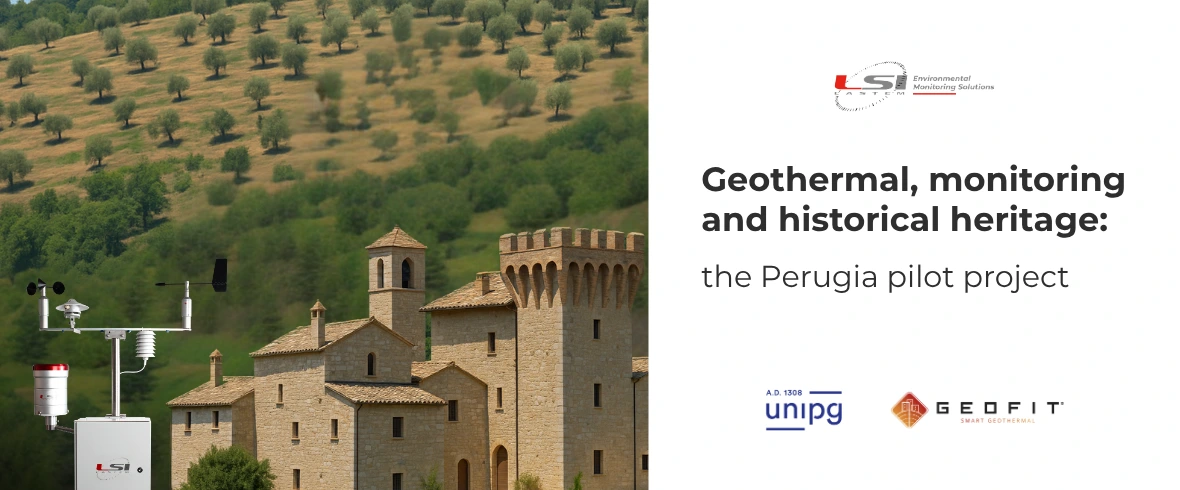
In the heart of Umbria, central Italy, among the hills surrounding Perugia, lies a medieval complex of great historical value: the Rocca Sant’Apollinare. Once the stables of the Benedictine monastery, it is now a cutting-edge research center. This site is the focus of an ambitious sustainable redevelopment and environmental monitoring project that combines cutting-edge technologies, heritage protection, and citizen well-being. Furthermore, the stables have obtained the first GBC Historic Building certificate in Italy and the Ecomondo award for sustainable construction, confirming the quality and innovation of the project.
GEOFIT: an innovative approach to geothermal refurbishment
The European GEOFIT project, funded by the EU’s Horizon 2020 program, aims to revolutionize the energy renovation of buildings through a holistic and innovative approach based on the use of geothermal energy. The goal is to develop systems that are cost-competitive, easy to install, and capable of ensuring efficient low-temperature heating and effective high-temperature cooling, using the most advanced technologies and methods available.
To test and validate these solutions, GEOFIT has been successfully implemented at five pilot sites across Europe, including Ireland, Italy, France, and Spain. The selected sites represent a broad spectrum of climate conditions, building types, and geological characteristics, making the project a true open-air laboratory for energy refurbishment in real-world settings.
Rocca Sant’Apollinare: a pilot site of excellence
Rocca Sant’Apollinare (PG) is one of five pilot sites chosen to test these innovative technologies. In the case of Perugia, the objective was challenging: to apply a cutting-edge hybrid geothermal system to a building dating back to the 10th and 11th centuries, with significant cultural value and located in a seismic zone. Here, the University of Perugia, project leader for this site, collaborated with several industrial and technological partners to integrate a hybrid heat pump and an unconventional horizontal heat exchanger, all supported by digital modelling and advanced simulations.
Finally, the entire system is monitored and managed by an intelligent Building Energy Management System (BEMS) that optimizes energy efficiency while maintaining a high level of environmental comfort for residents.
Invisible technology for heritage protection
The project addressed several critical issues:
- How to reduce consumption and emissions without invasive interventions?
- How to integrate geothermal systems and monitoring systems into a heritage building?
- How to ensure environmental comfort for users?
The answer came from an innovative design approach, combining efficiency and respect for the historical context. The interventions were carried out with excavations limited to a depth of 2.5 meters, through five parallel trenches and underground heat exchange rings, minimizing the visual and structural impact.
Why environmental monitoring is essential
To ensure accurate control of comfort and energy efficiency, the continuous monitoring system implemented at Rocca Sant’Apollinare uses two types of LSI LASTEM stations:
- Outdoor weather station: measures temperature, humidity, atmospheric pressure, wind speed and direction, solar radiation, and precipitation;
- Indoor microclimate station: measures indoor temperature and humidity, black globe temperature, wet bulb temperature, and air velocity.
Jointly monitoring indoor and outdoor conditions is essential for assessing thermohygrometric comfort, analyzing building-environment energy balances and optimizing plant management through predictive strategies. This approach allows for objective correlation of environmental data with consumption, improving efficiency and well-being.
How the data is used: analysis, optimization, and research
The collected data is then processed through digital platforms and used to:
- Optimize system operation and reduce waste;
- Evaluate environmental quality and microclimatic comfort;
- Support scientific research and educational activities;
- Share best practices with European institutions and stakeholders.
Concrete impacts: efficiency, well-being, and enhancement
The Rocca Sant’Apollinare project has generated tangible benefits:
- Reduction in energy consumption and CO₂ emissions;
- Improved air quality and comfort for students and researchers;
- Protection of historical heritage, thanks to a non-invasive approach;
- Training and innovation, with a participatory laboratory available to the University and scientific partners.
A model replicable for other buildings
The project looks to the future with the intention of extending the sensor network to other urban and historic contexts, integrating smart technologies to optimize energy management and microclimate control. The collaboration between LSI LASTEM and the University of Perugia has created a virtuous model of cooperation, replicable nationally and internationally. The long-term goal is to make the Rocca Sant’Apollinare a European benchmark for the sustainable redevelopment of historic heritage.
A new direction for sustainable redevelopment
The Rocca Sant’Apollinare project demonstrates that it is possible to combine historical heritage protection and ecological transition through advanced technological solutions. LSI LASTEM, with its environmental monitoring systems, contributed to defining an operational model capable of enhancing complex architectural contexts and promoting more informed energy management. An approach based on accurate and reliable data, interdisciplinary cooperation, and strategic vision that paves the way for new opportunities for the future of sustainable redevelopment.