
A microclimate tailored to everyone in a shared room?
The University of Sassari tests climate control using sensors and artificial intelligence

A microclimate tailored to everyone in a shared room? The University of Sassari tests climate control using sensors and artificial intelligence

How can building comfort be improved to meet the needs of occupants without compromising energy efficiency?

This challenge inspired a research project conducted by the Department of Architecture at the University of Sassari, coordinated by Professor Antonello Monsù Scolaro. LSI LASTEM instrumentation was used to monitor the environmental conditions of a residential prototype as part of a study integrating microclimatic monitoring, Artificial Intelligence and climate control systems.

By measuring indoor and outdoor temperature, indoor and outdoor relative humidity, and indoor mean radiant temperatures, researchers collected data to support the development of a climate control system capable of adapting to environmental conditions and users’ preferences regarding their perceived comfort.

The Context: A Residential Prototype to Study Personalised Comfort

The experiment is part of a project funded under the Sustainable Growth Fund – Smart Factory (Fondo per la Crescita Sostenibile – Fabbrica Intelligente), involving industrial companies such as Gresmalt and SACMI, as well as academic institutions, including the Free University of Bozen–Bolzano and the University of Calabria.

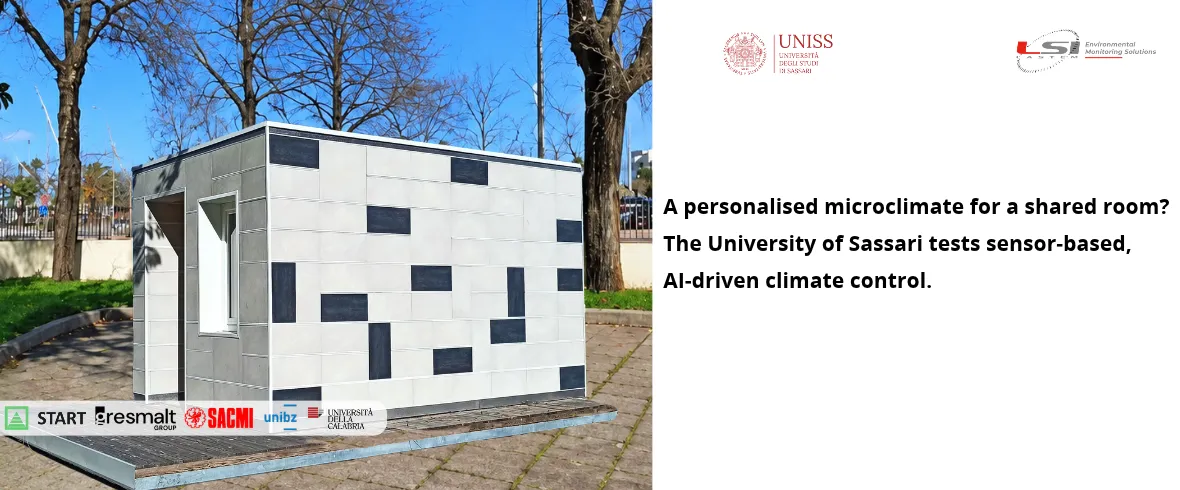
The University of Sassari research team developed a residential prototype of approximately 10 m², featuring a demountable wooden structure, rock wool insulation, an air cavity and external ceramic cladding.

Within this environment, researchers conducted an experimental study involving real participants to compare microclimatic conditions with the comfort perceived by individuals.

During the study, each participant spent approximately 20 minutes inside the prototype to acclimatise to the environmental conditions. Afterwards, each person completed a questionnaire about their perceived well-being and individual factors, such as clothing and activities performed, to help define individual thermal comfort profiles.

From Artificial Intelligence to Climate Control

Once the individual comfort profiles had been defined, the research focused on how to use this information to automatically manage the climate control system through Machine Learning and Deep Learning techniques.

These technologies enabled the development of algorithms capable of learning from data and identifying relationships between different parameters, anticipating the creation of “ideal” indoor comfort conditions through their self-training capabilities.

To apply this approach to the residential prototype, researchers developed a system capable of recognising the people present and using their respective comfort preferences. Each participant was assigned an RFID tag, a small device that allows them to be identified when entering the environment.

Once the occupants have been recognised, the software retrieves their profiles and sends the information to an algorithm. The algorithm calculates a shared control setpoint, taking into account their different needs.

The algorithm also integrates data collected by LSI LASTEM instrumentation to determine the commands to be sent to the air conditioning unit, the only device controlled by the experimental system.

The LSI LASTEM Solution: Environmental Monitoring Supporting Research

To acquire the data required for the experiment, researchers used an LSI LASTEM environmental monitoring system consisting of sensors for measuring microclimatic parameters, a data acquisition unit and dedicated software for data management and analysis.

The instrumentation played a fundamental role in studying indoor comfort and the building’s thermal behaviour through various measurement and analysis activities.

1. Monitoring Indoor and Outdoor Environmental Conditions

Researchers used temperature and humidity sensors, globe thermometers, lux meters and sound level sensors to measure air temperature and relative humidity, mean radiant temperature, illuminance and sound levels.

The instrumentation also included anemometers to measure air velocity both inside and outside the prototype.

2. Analysing the Thermal Behaviour of the Building Envelope

The system includes surface temperature sensors and a kit for calculating the thermal transmittance of opaque walls, used to study the thermal performance of the building envelope.

Surface temperature measurements enabled researchers to analyse heat exchange between the interior and exterior of the structure.

3. Environmental Data Acquisition and Analysis

The LSI LASTEM data acquisition unit collected measurements from the sensors.

The software suite included CommNET/GPRS, GidasTEA for thermal comfort and heat and cold stress analysis, and InfoFLUX for calculating wall thermal transmittance. These tools supported environmental data management and analysis, as well as the assessment of indoor comfort and the building’s thermal behaviour.

4. Supporting the Development of Intelligent Climate Control

The environmental data collected were used to compare microclimatic conditions with participants’ perceived comfort and to support the development of the climate control system.

Integrating these measurements with the algorithms developed by the research team represented an important step towards controlling the system based on environmental conditions and occupants’ needs.

Key Findings from the Experiment

Researchers at the University of Sassari collected environmental data over several months, monitoring and analysing the prototype’s behaviour under different climatic conditions.

From a technological perspective, it was possible to establish an operational relationship between occupant recognition, microclimatic measurements, data processing software and the climate control system.

This made it possible to verify the algorithm’s ability to process the information received and to proceed with fine-tuning the commands sent to the air conditioning unit.

Conclusions: New Perspectives for Environmental Monitoring

The University of Sassari project highlights the potential of environmental monitoring in developing intelligent building management systems, where measurements become an integral part of control processes.

A promising future development involves activating climate control systems, or other devices, according to actual surrounding climatic conditions, in both summer and winter. The aim is to optimise their operation based on users’ needs and consequently reduce actual energy consumption.

The research therefore opens up opportunities for further applications, from automated natural ventilation management to the control of other devices, with the goal of developing solutions that combine personal comfort with energy efficiency.

Scarica l’articolo:

FAQ: Frequently Asked Questions

LSI LASTEM instrumentation was used to monitor environmental conditions both inside and outside the residential prototype. The collected data enabled researchers to study occupants’ comfort and provided valuable information for developing an intelligent climate control system.

LSI LASTEM sensors measured indoor and outdoor air temperature and relative humidity, surface temperatures, indoor mean radiant temperature, luminous flux and sound levels.

Measurements of the building envelope’s surface temperatures, together with a heat flux meter installed on the internal surface, were also used to study heat exchange between the interior and exterior.

The instrumentation included temperature and humidity sensors, a globe thermometer, hot-wire anemometers, a luxmeter, surface temperature and heat flux sensors, a sound level sensor and a data acquisition unit.

These instruments enabled researchers to collect information on various environmental factors that contribute to perceived comfort.

However, the luxmeter and sound level sensor do not provide data directly related to optimising the operation of the climate control system.

Environmental measurements were integrated with the individual comfort profiles developed by the researchers.

This information supported the development of algorithms designed to determine climate control settings based on environmental conditions and occupants’ preferences.

The software suite included CommNET/GPRS, GidasTEA for thermal comfort and heat and cold stress analysis, and InfoFLUX for calculating wall thermal transmittance. 

These tools were intended for managing and processing environmental measurements and studying comfort conditions and the building’s thermal behaviour.

Contattaci per ricevere maggiori informazioni
Drag & Drop Files, Choose Files to Upload You can upload up to 6 files.
Caselle di Spunta