
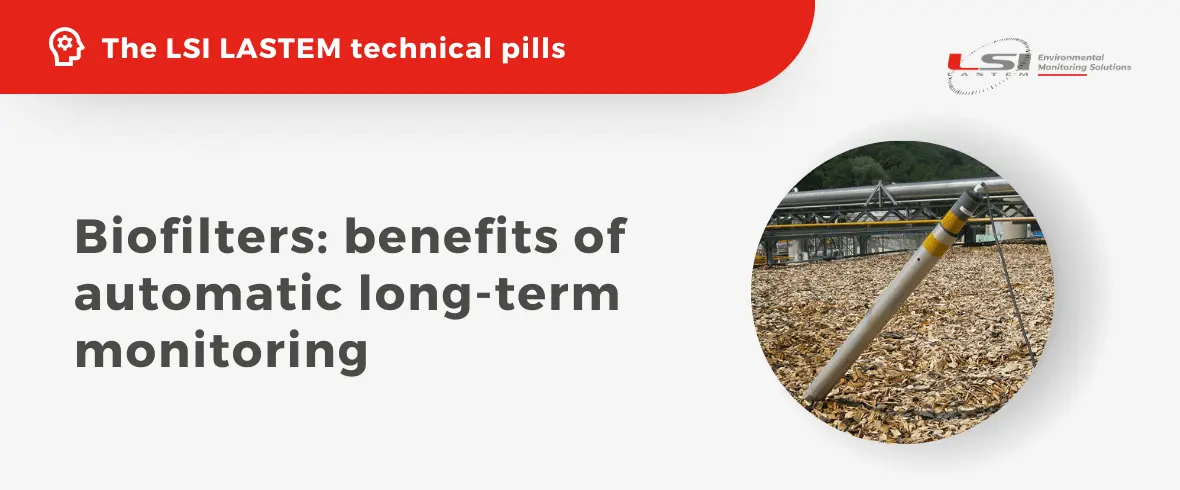
Biofilters: benefits of automatic long-term monitoring

Biofilters

The continuous monitoring of the biofilter has become an increasingly requested practice, in a period in which attention to sustainable waste management and environmental protection are issues of great importance. LSI LASTEM is among the few companies in Italy capable of providing a complete solution for landfills or industrial plants, including monitoring of the biofilter, compost, if present, and meteorological conditions.

Biofiltration: a solution for odour treatment

Odour management is a major challenge in composting, bio-drying and industrial plants. The odours produced in such plants can be eliminated through various technological solutions. Among these, biofiltration systems have demonstrated good removal capabilities of odour pollutants, adapting to changes in the composition of emissions over time.

Biofiltration is a technology that exploits a biologically active porous medium, such as bark, shredded wood, mature compost, peat, etc., colonised by aerobic microorganisms capable of degrading the polluting compounds present in the emissions. Through the biofiltration process, volatile organic compounds and reduced sulphur and nitrogen compounds are removed.

Continuous biofilter monitoring: benefits and applications

Continuous monitoring of key biofilter parameters, such as temperature and water content, offers numerous benefits and opportunities for process optimisation:

  • Constant control of biofilter efficiency: by monitoring the temperature and water content of the biofilter in real time, it is possible to guarantee constant efficiency in the treatment of polluting and malodorous compounds.
  • Automation and cost reduction: Continuous monitoring avoids the need for periodic manual measurements, reducing operating costs and reliance on human operators.
  • Longer life of the wood chips: by optimising the parameters of temperature and water content, it is possible to increase the life of the filter material in the biofilter.
  • Automatic irrigation system: with an automatic irrigation system, it is possible to constantly keep the water content of the biofilter within the ranges required by law.
  • Verification of the thermo-hygrometric conditions: by measuring temperature and humidity of the air entering the biofilter, it is possible to compare these data with those detected inside the biofilter itself.
  • Differential pressure measurement: the measurement of the differential pressure in the ducts is useful for detecting any pressure drops during the air intake phase through the biofilter.
  • Control of the pH of the leachate: the pH value of the leachate leaving the biofilter must remain between the value 5 and the value 7 to guarantee the efficiency of the process.

Designing a biofiltration plant with LSI LASTEM technology

To design an optimal biofiltration plant, it is crucial to monitor key parameters during the process. LSI LASTEM provides sensors specifically designed for continuous monitoring of temperature, oxygen and water content in biofilters and compost heaps during bio-oxidation.

LSI LASTEM sensors are robust and designed to withstand harsh environmental conditions. They can be used for both biofilter monitoring and compost monitoring. Thanks to radio technology, the sensors can be easily moved without the use of cables. They can also be wired, offering flexibility and practicality according to the needs of the system.

The data collected by the sensors can be managed with optional solutions supplied by LSI LASTEM, such as data loggers, software and communication devices, or with third-party systems. This comprehensive data management enables precise and optimised control of the composting and biofiltration process.

Conclusions

Biofiltration technology proves to be an effective and ecological solution for the treatment of odorous emissions, with a reduction of polluting compounds close to 99%. With the help of the innovative LSI LASTEM instrumentation, plants can achieve high levels of sustainability and efficiency, contributing to environmental protection and improved air quality.

FAQ: Frequently Asked Questions

Continuous biofilter monitoring helps keep under control the parameters that affect odor removal efficiency, such as temperature and water content. This makes it easier to detect anomalies, optimize plant operation, and reduce the risk of performance drops.

In a biofilter, it is useful to continuously monitor parameters such as temperature, humidity or water content of the filter material and, depending on the plant, also duct parameters such as relative humidity, air velocity, pH, and differential pressure. These data help assess the system’s operating conditions and plan timely interventions.

Automatic monitoring provides continuous data rather than occasional measurements only. This makes it possible to track how the process evolves over time, better document operating conditions, support maintenance activities, and improve the operational stability of the biofilter.

Yes, integrating a biofilter with a weather station is useful because weather data help interpret plant behavior more effectively and assess the possible dispersion of odors in the surrounding area. For many plants, linking process data with weather data makes monitoring more complete and effective.

Yes. LSI LASTEM solutions can cover biofilter monitoring, weather monitoring, compost monitoring, if present, and, when required, leachate water monitoring as well. This integrated approach is useful for composting plants, biodrying plants, landfills, and other waste management sites.

Contact us for more information
Drag & Drop Files, Choose Files to Upload You can upload up to 6 files.
Checkbox