


Why the Size of a Rain Gauge Orifice Is Crucial: WMO Guidance and Risks of Oversized Openings
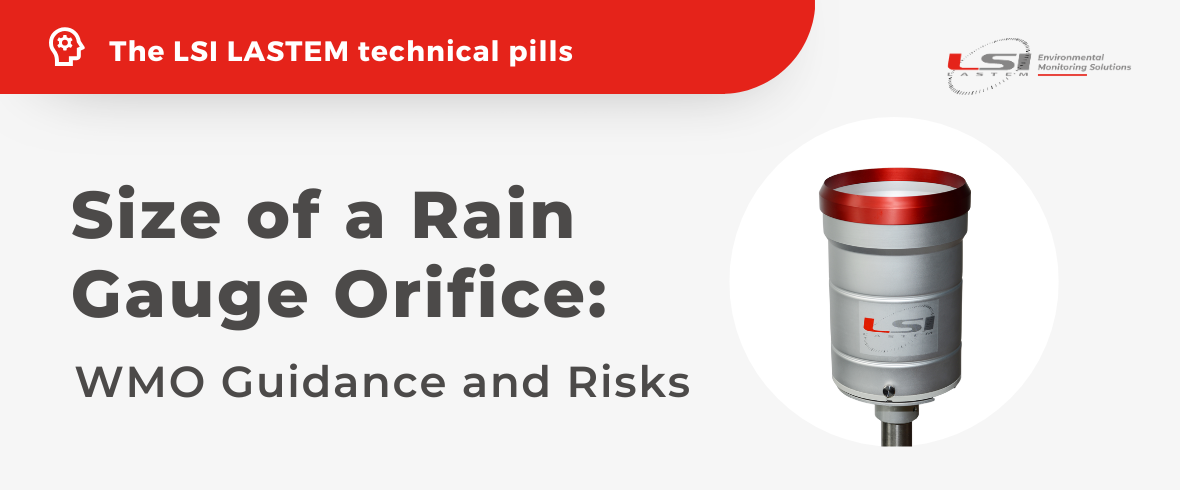
Introduction
The WMO guide “Guide to Instruments and Methods of Observation (WMO No. 8)” contains important recommendations for precipitation measurement, including the size of the collecting orifice of rain gauges.
Required Rain Gauge Characteristics According to WMO Guide No. 8
1. Instrument and measurement principle
- The rain gauge is typically an open container with vertical walls that collects incoming precipitation.
- Measurement is expressed as the vertical height of water (or the equivalent for solid precipitation) over the horizontal plane of the Earth’s surface.
- The container may be simple (a cylindrical vessel) or fitted with a funnel. It is essential that the opening has known dimensions and that these are kept constant.
2. Exposure and positioning
- The rain gauge must be positioned so that the collected amount is as representative as possible of the precipitation reaching the ground in the surrounding area. Wind exposure, instrument tilt, and obstacles must be carefully considered.
- The dimensions, shape, and position (height above ground) of the orifice must be documented.
3. Orifice of the container
- The Guide stresses that “various gauge heights and sizes and shapes of orifice are used in different countries, measurements are not strictly comparable.”
- One reference states that “an area of at least 200 cm² is required […]. Gauges with collecting areas of 200 to 500 cm² are the most common […].”
- From this it follows that the recommended opening is at least 200 cm², with typical values in the 200–500 cm² range.
4. Other technical and operational characteristics
- The container must be leveled, with the upper rim horizontal.
- Vertical walls must avoid turbulence or excessive splashing.
- Maintenance, calibration, and documentation of instrument conditions must be carried out.
- Errors related to wind, evaporation, overflow, etc., must be considered.
Recommended Orifice and Collection Characteristics
According to WMO Guide No. 8:
- The rain gauge must have a well-defined and constant orifice to allow conversion of collected volume into water height on the horizontal ground plane.
- Good exposure is required, with no tilt, vertical walls, and a horizontal orifice rim.
- The size, shape, and condition of the opening significantly affect actual catch, especially under wind, heavy rainfall, or solid precipitation.
It should be noted that the Guide does not specify a universally valid absolute maximum area, but recommends standardized measurements to ensure comparability and accuracy. However, operational and comparative experience has shown that overly large openings can produce systematic effects.
Why an Overly Large Orifice Can Generate Systematic Errors
When the rain gauge orifice is significantly larger than recommended (e.g., 1000 cm²), several types of systematic errors may occur, including:
1. Turbulence and deflection of drop trajectories
A large opening alters the aerodynamic effect around the rim and above the gauge orefice. Airflow over the opening accelerates or deforms, changing drop trajectories and reducing catch. Side walls may not be sufficiently high or “sharp” relative to the opening area, allowing drops to deviate. In mixed rain/snow or snow conditions, wind effects are amplified: lighter particles or those with altered paths may fail to enter the gauge.
2. Greater wind influence / “wind-induced undercatch”
Large orifices can worsen wind effects that divert drops away from the opening. Wind speed, drop size, mouth shape, and container geometry are among the main factors that reduce effective catch.
3. In- and out-splash and loss due to splashing
A wide opening catches more drops, but also more splashes and rebounds. Drops falling near the rim can bounce outward (splash-out), or lateral splash-in may occur, both altering the measurement.
4. Wetting loss (water sticking to walls) and increased evaporation
With a very wide orefice, the inner surface area of side walls (or funnel) is larger, so the absolute amount of water adhering to the walls (wetting) can be higher. In addition, collected water has a larger contact surface, promoting evaporation or lateral drainage. This is especially relevant in places and periods with low rainfall, when small residual amounts may evaporate and go uncounted—an effect magnified by larger area.
5. Overload and overflow / errors during intense precipitation
A very wide opening can collect large volumes quickly during intense events. If the instrument is not designed for these conditions, overflow or erroneous measurements may occur.
Water may spill before being correctly recorded, causing underestimation. Outlet structures (funnel, tube, valve) may not discharge fast enough, leading to non-linear accumulation.
6. Issues related to cleaning the rain gauge outlet filter
Rain collected through the orifice is conveyed by the funnel to the outlet and then to the tipping bucket, passing through a filter. The filter stops leaves, dust, or other impurities that could affect the tipping mechanism. A larger collecting area gathers more debris, increasing the risk of clogging.
7. Representativeness and comparability problems
A very wide orifice can alter measurement representativeness compared to other standardized instruments. This means:
- Measurements are not comparable with stations using smaller standard openings.
- In monitoring networks, a systematic bias is introduced that complicates historical comparisons.
- Historical series may become non-homogeneous if a non-standard gauge is used alongside compliant ones.
Practical Example: 1000 cm² Orifice Area
Using a 1000 cm² orifice (diameter ~35.7 cm) as an example, the following implications can be highlighted:
- The area is far above the recommended few hundred cm² range.
- Under moderate wind, drop deviation from the opening may be worse than with a smaller area.
- The absolute number of drops falling near the rim is higher, so the percentage loss from splash-out or deflection may increase.
- If the structure is not designed to discharge large volumes quickly, overflow becomes a concrete risk.
- Wetting and evaporation losses may become more significant relative to the collected rainfall, worsening systematic error.
- If a station network uses standard openings (e.g., 200–500 cm²) and one station uses 1000 cm², data from the “anomalous” station will likely be lower or not comparable (depending on wind, intensity, and precipitation type) versus others.
Operational Recommendations
Considering the above, to ensure good precipitation measurement quality it is recommended to:
- Use an orifice area that conforms to standards (ideally within the range suggested by WMO guidance and normative practice) and always document area, shape, height above ground, and exposure.
- Verify that installation location is open, leveled, far from obstacles, and wind-shielded if needed.
- Check that the collection system drains correctly and is not subject to overflow.
- Perform regular maintenance: cleaning the opening and checking for deformation or damage.
- Document conditions and record any deviations from standard instrumentation to ensure transparency in historical series.
Conclusion
An overly large rain gauge orefice—such as a 1000 cm² opening—represents not only a departure from WMO recommendations but also a serious risk of systematic precipitation measurement errors. These errors include wind undercatch, splash-out, increased evaporation and wetting losses, overflow, and representativeness/comparability issues.
For precise, reliable, and comparable precipitation measurements, it is therefore essential to respect the dimensions, shape, positioning, and maintenance recommended by WMO No. 8, and to treat instruments that deviate significantly from these specifications with caution.
Download the article:
FAQ: Frequently Asked Questions
Why is the size of the rain gauge orifice so important?
Because the opening of the rain gauge directly affects collection quality and therefore the final precipitation measurement. WMO No. 8 states that the orifice must be well defined, constant, and properly exposed, because its size, shape, and condition affect both data accuracy and comparability.
Does a larger orifice always measure rainfall better?
No, very large openings can introduce systematic errors caused by turbulence, wind undercatch, splash-in/splash-out, increased wetting, and representativeness issues compared with standardized instruments. In practice, an oversized orifice does not guarantee a better measurement and may make data less reliable and less comparable with historical series.
What dimensions does the WMO recommend for a rain gauge orifice?
WMO No. 8 indicates that the orifice area should be at least 200 cm² and that instruments with openings between 200 and 500 cm² are widely used. This does not mean that there is one single universally valid value, but rather that orifice standardization is essential for obtaining comparable and technically sound measurements.
How do LSI LASTEM rain gauges help ensure reliable measurements?
LSI LASTEM rain gauges are designed according to WMO recommendations and provide rainfall intensity accuracy in Class A according to UNI 11452:2012. In addition, the range includes models with a siphon to regulate the flow to the tipping bucket during intense rainfall, a useful solution when long-term rainfall total reliability is a priority.
What advantages does the LSI LASTEM range offer for meteorological applications?
The LSI LASTEM range is designed to suit different needs, with a Class A version, heated versions, and integration options with pulse outputs, 4-20 mA, or Modbus via external units. This makes it possible to choose the most suitable configuration for the application while maintaining a strong focus on robustness, compliance, and measured data quality.