


Modem or Router? Selection guide for effective remote monitoring
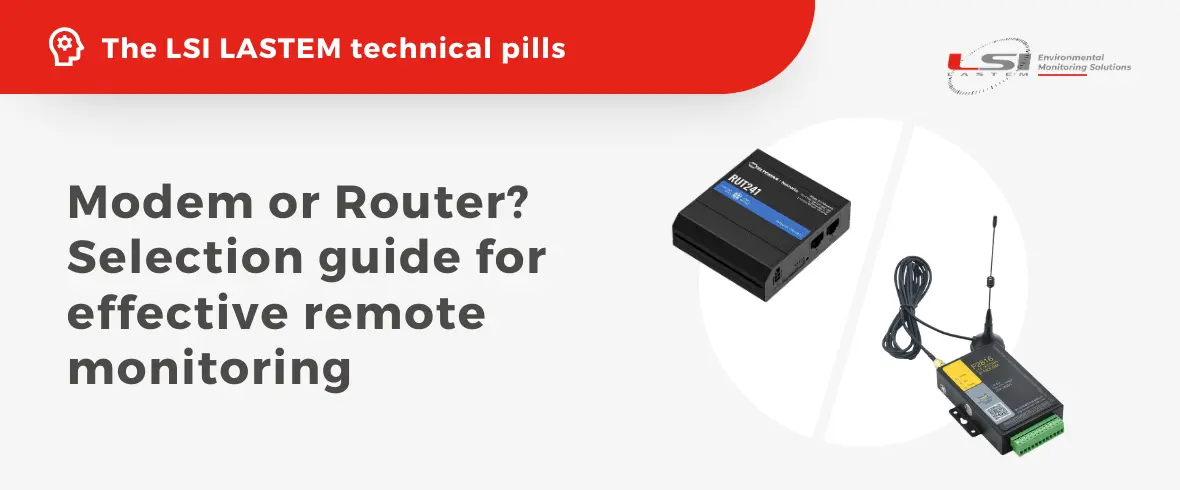
When it comes to configuring a monitoring system with remote communication, it becomes essential to identify which is the most suitable tool for sending data. The choice between modem and router is not always immediate and depends on the specific needs of the customer, the installation site and the type of equipment installed. This technical pill aims to help the customer choose the most suitable instrument for their monitoring needs and which can guarantee optimal operation of the station.
What is a modem?
A modem is a transceiver device that plays a key role in transmitting data in both analog and digital form. The term “modem” comes from its main function of modulation and demodulation, which involves converting sequences of bits into electrical signals.This process enables communication between digital devices and network infrastructures that rely on analog signals or simplified transmission protocols.
Basically, the modem is a telephone connection device that is used to connect a terminal, such as a data logger, to a data transmission network. In practice, this means that the modem converts, then modulates, digital signals into analog pulses during transmission and, conversely, demodulates analog pulses into digital signals during reception. There are modem models that can be connected either to the landline or to mobile networks through the use of a SIM card.
Application and advantages of modem
The mobile modem supplied by LSI LASTEM is mainly used with devices that only have an RS232 serial interface and in situations where low power consumption is required.
Pros: energy efficiency and SMS functionality
- Low power consumption: the modem ensures reduced energy usage, making it ideal for scenarios where energy efficiency is essential. Reduced power consumption helps maintain the station’s efficiency over time, limiting the need for frequent interventions and enabling more stable management of the communication infrastructure.
- SMS sending capability: thanks to the modem, it is possible to send SMS messages containing monitoring data, which is useful in many applications. This feature represents a concrete advantage in remote supervision applications, as it enables the immediate transmission of essential information even in scenarios where a continuous data connection is not available. Sending SMS messages allows data or alerts to be delivered in a simple and direct way, making the system versatile and suitable for different operational needs, especially when rapid notification plays a crucial role. and suitable for different operational needs, especially when rapid notification plays a crucial role.
Cons: SIM required and other considerations
- Configuration interface not accessible remotely: modem configuration can be complex remotely, making remote management difficult;
- Need for a SIM card: a SIM card is always required, which limits the possibility of interfacing the modem to a local network (LAN or WI-FI);
- Narrowband data transmission: the modem has a limited data transmission capacity compared to a router.
What is a router?
A router is a network device that provides Internet connectivity and is responsible for managing incoming and outgoing data packets between one or more nodes within a computer network. This network can be either local or geographically distributed.
In addition, routers store routing tables, which allow data packets in transit to understand the network topology and select the most efficient path to reach their destination. Finally, as with modems, there are router models that can connect either to fixed-line networks or to mobile networks through the use of a SIM card.
Use and advantages of the router
The router supplied by LSI LASTEM can be used in all contexts in which the acquisition devices are connected via a broadband Ethernet or Wi-Fi interface.
Pros: connection flexibility, multi-device management, remote configuration
- Ability to connect to a Wi-Fi and 4G/5G network: the router offers flexibility, allowing connection to both Ethernet and wireless networks, including 4G/5G services through the SIM card;
- Multi-device management: a router allows the simultaneous management of multiple devices, ideal for complex installations;
- Remotely accessible configuration interface: the router’s configuration interface is easily accessible remotely, simplifying remote management;
- Easy setup and compatibility: the router is generally easy to setup and is compatible with a wide range of capture devices;
- Always on and self-restoring connection: the router offers the possibility of maintaining an always active and self-restoring connection in the event of interruptions;
- The router is also a modem: while the modem is one-way, the router acts as a modem and a router, offering a versatile option.
Cons: high power consumption
- Higher power consumption: routers generally consume more energy than modems;
- No SMS capability: unlike a modem, a router often does not support SMS sending functionality.
Conclusions
The choice between a modem and a router depends on the specific monitoring requirements and the installation conditions. A modem offers low power consumption and the ability to send SMS messages, but it has some limitations in terms of remote configuration. On the other hand, a router provides greater flexibility, supports multiple devices, and offers a more accessible configuration interface, but it comes with higher energy consumption and typically does not allow SMS sending.
From a decision-making perspective, the modem represents the ideal solution for simple, low-power installations with limited data transmission needs, while the router is better suited for complex, scalable systems requiring high connectivity.
Customers should carefully evaluate these characteristics in order to make an informed decision that best suits their specific installation.
Download the article:
FAQ: Frequently Asked Questions
What is the difference between a modem and a router in a weather station?
A modem connects the data logger to the data network and is useful when low power consumption and SMS transmission are required. A router, on the other hand, manages network traffic, connects multiple devices, and provides easier remote access, often via Ethernet, Wi-Fi, and 4G/5G mobile networks.
When should you choose a modem for weather monitoring?
A modem is recommended when the weather station operates in locations with limited power supply and needs to transmit small amounts of data with maximum energy efficiency. It is also a practical choice when SMS notifications are required.
When is a router better for a weather station?
A router is the best option when multiple devices need to be connected, when using Ethernet or Wi-Fi networks, when remote configuration access is required, and when a more stable, self-recovering connection is needed. For advanced weather systems or distributed monitoring networks, a router is generally more suitable.
Does a router consume more power than a modem?
Yes, in general a router consumes more energy than a modem because it offers more network functions, remote management, and connectivity for multiple devices. For this reason, in weather stations powered by batteries or solar panels, energy consumption is one of the key selection criteria.
How to choose between a modem and a router for a customer installing a weather station?
The choice depends on three main factors: available power consumption, the number of devices to connect, and the level of remote access required. In short: choose a modem for simple, low-power installations; choose a router for weather stations with a more complete data network, remote management, and greater scalability.