


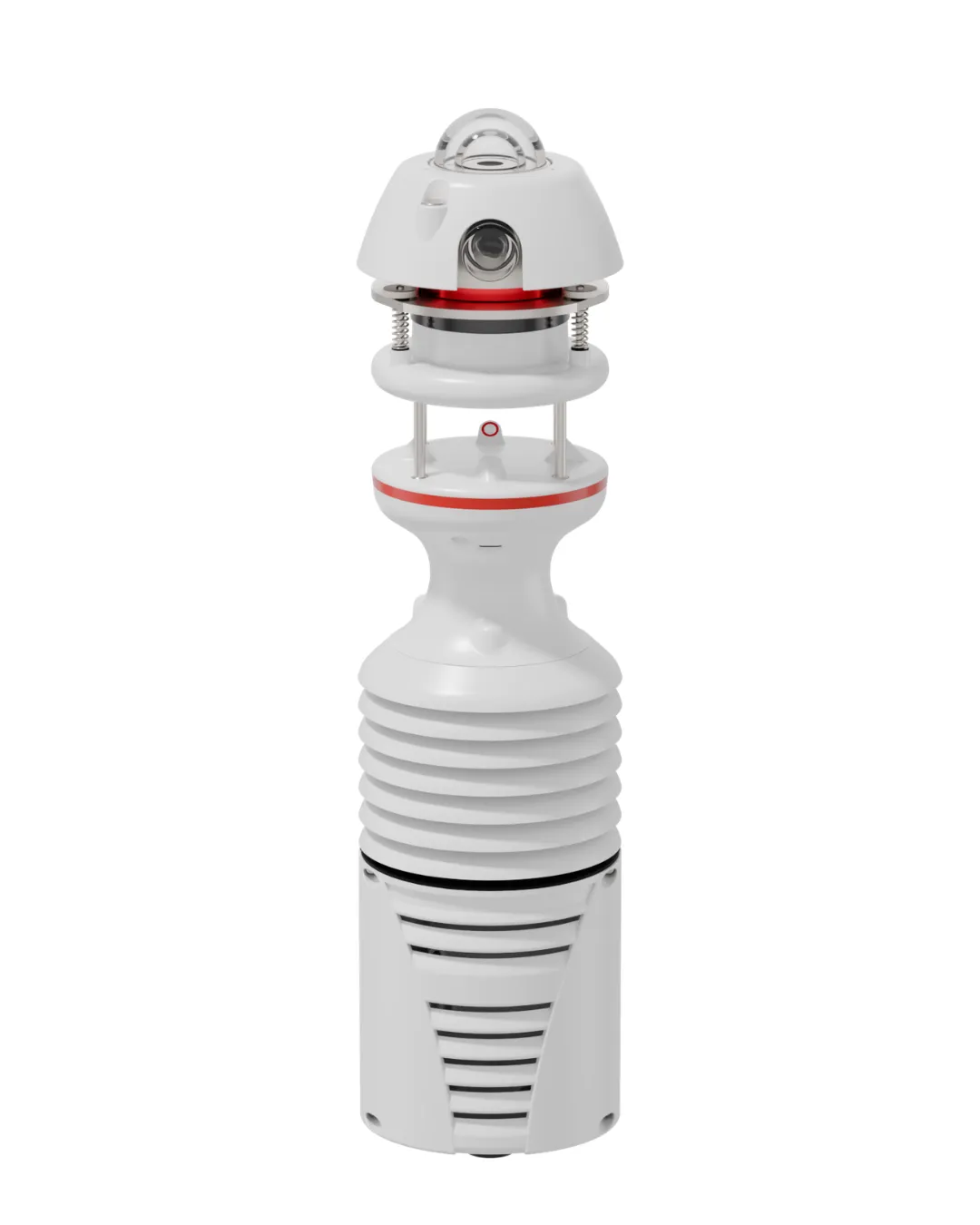
Ultrasonic anemometer compact
Ultrasonic Anemometers are the ideal sensors for general meteorological applications requiring no moving parts for low-maintenance or measurements with fast response even in very low-range wind speed conditions.
Model DNB205 (serial output) is a compact size sensor very suitable in lite weather stations. Heated version available.
DATA SHEETS
Description
Description
Ultrasonic anemometer compact
Highlights
- No moving parts;
- Compact, lightweight models made from Luran, suitable for both fixed and portable applications;
- Digital outputs (RS485 and RS232);
- Heated version available;
- Certifiable by the ISO/IEC 17025-accredited LSI LASTEM laboratory.
- Model codes: DNB205.1, DNB205, DNB205.2.
FAQ: Frequently Asked Questions
What are the main advantages of ultrasonic anemometers for measuring wind speed and direction?
Ultrasonic anemometers measure wind speed and direction without moving mechanical parts. This reduces maintenance requirements and enables a fast response even at low wind speeds. The LSI LASTEM range includes models with response times as short as 250 ms and measurement thresholds down to 0.01 m/s, depending on the version. The range also includes models with accuracies compliant with WMO specifications.
Are LSI LASTEM ultrasonic anemometers suitable for both low and very high wind speeds?
Yes, provided that the appropriate model is selected. The range includes sensors with very low measurement thresholds, down to 0.01 m/s, for applications where light winds must also be detected, as well as a dedicated high-speed version with a measuring range up to 85 m/s. Response times can be as short as 250 ms, allowing rapid changes in wind conditions to be tracked.
Which outputs and communication options are available for ultrasonic anemometers?
The range includes versions with 4…20 mA analogue outputs and digital RS232 or RS485 interfaces with Modbus RTU protocol. Depending on the configuration, ToTEM models also offer local digital communication or remote data transmission via LoRa radio or an integrated LTE-M modem with eSIM. This allows the sensor to be selected according to the acquisition-system architecture and the need for local or remote communication.
Can ultrasonic anemometers be used in snow and icing conditions?
Yes, but a heated version must be used where ice formation, snow, or snowfall may occur. The datasheet specifies an operating range down to -40…60 °C and explicitly recommends heated versions under freezing conditions. Smart heating is included in ToTEM models.
Can LSI LASTEM ultrasonic anemometers be calibrated according to ISO/IEC 17025?
LSI LASTEM operates a laboratory accredited according to ISO/IEC 17025 for air-speed measurements. All manufactured anemometers are tested internally and, on request, an ISO/IEC 17025-ACCREDIA calibration certificate can be provided for wind speed. Calibration reports according to ISO 9001 are also available for wind speed and wind direction.
Additional information
Additional information
Product
DNB205 - DNB205.1 - DNB205.2
Categories Meteo sensors, Sensors, Wind direction and speed
Ultrasonic anemometer compact
Highlights
- No moving parts;
- Compact, lightweight models made from Luran, suitable for both fixed and portable applications;
- Digital outputs (RS485 and RS232);
- Heated version available;
- Certifiable by the ISO/IEC 17025-accredited LSI LASTEM laboratory.
- Model codes: DNB205.1, DNB205, DNB205.2.
FAQ: Frequently Asked Questions
What are the main advantages of ultrasonic anemometers for measuring wind speed and direction?
Ultrasonic anemometers measure wind speed and direction without moving mechanical parts. This reduces maintenance requirements and enables a fast response even at low wind speeds. The LSI LASTEM range includes models with response times as short as 250 ms and measurement thresholds down to 0.01 m/s, depending on the version. The range also includes models with accuracies compliant with WMO specifications.
Are LSI LASTEM ultrasonic anemometers suitable for both low and very high wind speeds?
Yes, provided that the appropriate model is selected. The range includes sensors with very low measurement thresholds, down to 0.01 m/s, for applications where light winds must also be detected, as well as a dedicated high-speed version with a measuring range up to 85 m/s. Response times can be as short as 250 ms, allowing rapid changes in wind conditions to be tracked.
Which outputs and communication options are available for ultrasonic anemometers?
The range includes versions with 4…20 mA analogue outputs and digital RS232 or RS485 interfaces with Modbus RTU protocol. Depending on the configuration, ToTEM models also offer local digital communication or remote data transmission via LoRa radio or an integrated LTE-M modem with eSIM. This allows the sensor to be selected according to the acquisition-system architecture and the need for local or remote communication.
Can ultrasonic anemometers be used in snow and icing conditions?
Yes, but a heated version must be used where ice formation, snow, or snowfall may occur. The datasheet specifies an operating range down to -40…60 °C and explicitly recommends heated versions under freezing conditions. Smart heating is included in ToTEM models.
Can LSI LASTEM ultrasonic anemometers be calibrated according to ISO/IEC 17025?
LSI LASTEM operates a laboratory accredited according to ISO/IEC 17025 for air-speed measurements. All manufactured anemometers are tested internally and, on request, an ISO/IEC 17025-ACCREDIA calibration certificate can be provided for wind speed. Calibration reports according to ISO 9001 are also available for wind speed and wind direction.

