


Environmental monitoring and excellence in education: the case of the LSI LASTEM weather station at the Alessandro Volta High School (PA)
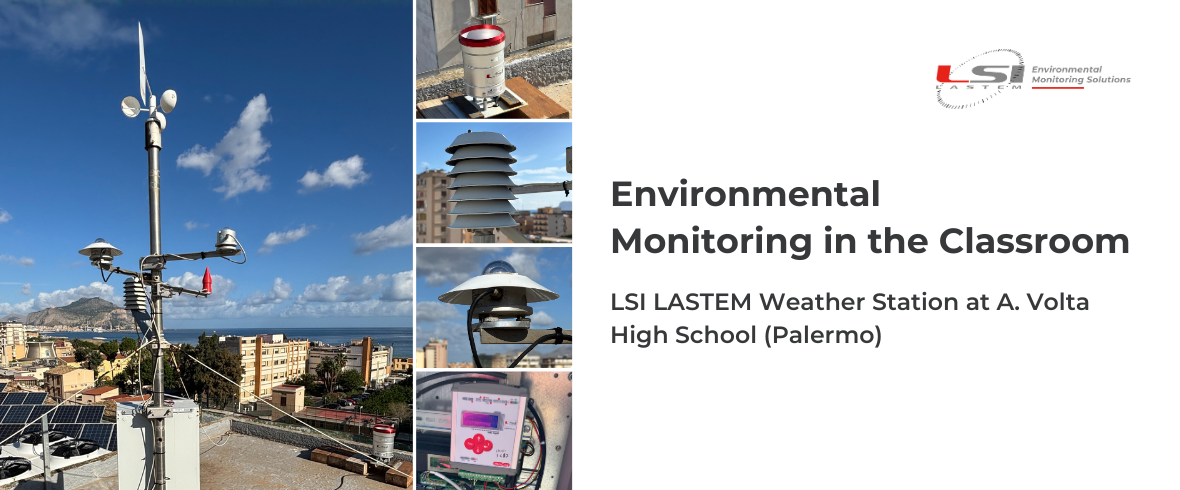
On the eastern coastal strip of the city of Palermo, in a complex urban context climatically influenced by exposure to the coast of the Gulf of Palermo, a project has emerged that combines technological innovation, environmental monitoring and advanced education. This is the project featuring the LSI LASTEM weather station installed at the Alessandro Volta High School in Palermo, a historic institution with over fifty years of activity and around 1,400 students.
This long-standing collaboration is a concrete example of how the integration of professional environmental monitoring systems in schools can create value for the local area, for institutions, and for the new generations of Green Economy professionals.
Why meteorological and environmental monitoring is strategic today
Collecting reliable meteorological and environmental data in a densely urbanized area like Palermo means continuously observing the evolution of local weather and climate conditions, air quality, and the interactions between the atmosphere, sea and city. This is not just a “weather forecast,” but also provides essential information for risk prevention, safety, and land-use planning.
The meteorological station installed at the A. Volta Institute also plays a key role for the local community. The data collected is used at the request of environmental monitoring institutions and supports studies and analyses useful for urban and sustainable development policies. In this scenario, the school takes on the role of a true scientific hub, capable of disseminating data and expertise at the local, regional, and national levels, while also strengthening students’ civic sense and environmental awareness.
An educational project that evolves over time
The project’s history is an example of continuous technological evolution. Between 1999 and 2004, thanks to European ERDF funding, the A. Volta Institute invested in LSI LASTEM analog meteorological and agro-meteorological instrumentation, becoming one of the first Italian schools to disseminate science and education nationwide, including through nationally formatted television programs such as the historic “Ambiente Italia“.
2015 marked the decisive transition to digital, with funding from the Ministry of Universities and Research for the acquisition, management, and interpretation of data using advanced IT platforms. From 2021 to 2024, the project will enter a new phase of experimentation and research on environmental sustainability and portable weather and environmental monitoring systems, with the A. Volta Institute leading a network involving ten high schools across the country.
The project’s value is strengthened by leading institutional collaborations, such as those with ENEA – in particular the Lampedusa Climatological Observatory – and with the Sicilian Region through the Sicilian Region’s Agrometeorological Information Service (SIAS), for the validation and use of meteorological and environmental data.
LSI LASTEM technology at the heart of the system
The technical heart of the project is LSI LASTEM technology. The weather station integrates latest-generation digital instrumentation designed to ensure reliable and continuous measurements.
The system is based on advanced data loggers, such as E-Log and Alpha-Log, which manage a broad set of meteorological sensors: an anemometer, a thermo-hygrometer, a barometer, a rain gauge, and a pyranometer. These are complemented by other instruments for environmental monitoring and air quality, including sensors for PM2.5, CO₂, CO, NO₂, and ground-level ozone, as well as a UV-A radiometer.
A distinctive feature is the storm front sensor, an exclusive technology that allows the tracking of electrical charges in the atmosphere and supports early warning systems for the presence of strong storms and thunderstorm fronts. This is an increasingly important aspect in a weather-climate context characterized by extreme events and increasingly tropical phenomena.
The project also includes indoor monitoring, with sensors experimentally installed in classroom-laboratories used daily by students, to monitor CO₂, TVOC, and PM10, actively contributing to health and well-being in school environments. All data is processed using professional software such as 3DOM and Gidas Viewer.
From laboratory teaching to professional training
The use of professional weather and environmental monitoring tools allows for moving beyond traditional teaching, transforming lessons into concrete experimental experiences. Students don’t just study atmospheric physics from textbooks; they analyze real-world data, learn to process and interpret it, and understand its impact on key sectors such as land management, sustainable agriculture, and tourism.
This approach also fosters greater awareness of climate change. Aspects such as tropicalization, desertification, the conscious use of natural resources, and recycling become an integral part of the curriculum, especially in new areas related to biotechnology and green chemistry. Direct experience with high-precision data and instruments allows students to transform an interest into a skill that can be applied to the workplace.
A replicable model for institutions and companies
The project at the Alessandro Volta High School in Palermo demonstrates how “smart” environmental monitoring can be a powerful driver of knowledge, prevention and sustainable development. It is a constantly evolving program, ready to integrate new technologies and expand through networks of interconnected weather stations and real-time data transmission.
For LSI LASTEM, this case represents a concrete example of the value its solutions can generate not only in industrial and institutional settings, but also in education and training.