
FIFA WORLD CUP 2026 – HEAT STRESS
Heat Stress at the FIFA World Cup 2026: Are Hydration Breaks Adequate?
Are hydration breaks adequate?
Request the full WBGT and sports safety report and discover how to monitor risk more accurately.
Enter your details and request the in-depth report.
Argomenti
Microclima indoor nei musei e ambienti confinati
Definizione, variabili fisiche, ruolo nelle sale espositive, teche, archivi. Importanza degli impianti tecnici, gestione schede prestito, condition report e movimentazione prestiti.
Contesto legislativo e norme tecniche
Il Codice TU 42/2004 impone il rispetto dei Livelli Minimi Uniformi di Qualità dei Musei (DM 21.02.2018), inclusa la gestione del rischio del microclima indoor. Le norme tecniche UNI 10829 regolano le condizioni ambientali e il microclima per la conservazione dei beni culturali.
Campagne di monitoraggio
Scelta di variabili e sensori adeguati, punti di misura rappresentativi in base alla collezione e allo spazio espositivo. Continuità nel controllo e monitoraggio in tempo reale, gestione remota digitale, generazione di report e comunicazione.
Variabili fisico-chimiche, danni e rischi di degrado
Condizioni ambientali, rischi da temperatura e umidità relativa, grandezze psicrometriche, vapor d’acqua e rischi associati ai manufatti. Polveri, movimento dell’aria, rischi legati a illuminazione, raggi UV e radiazione solare. Degrado legato alle diverse condizioni e materiali degli allestimenti.
REGULATIONS
What FIFA requires and what FIFPRO recommends
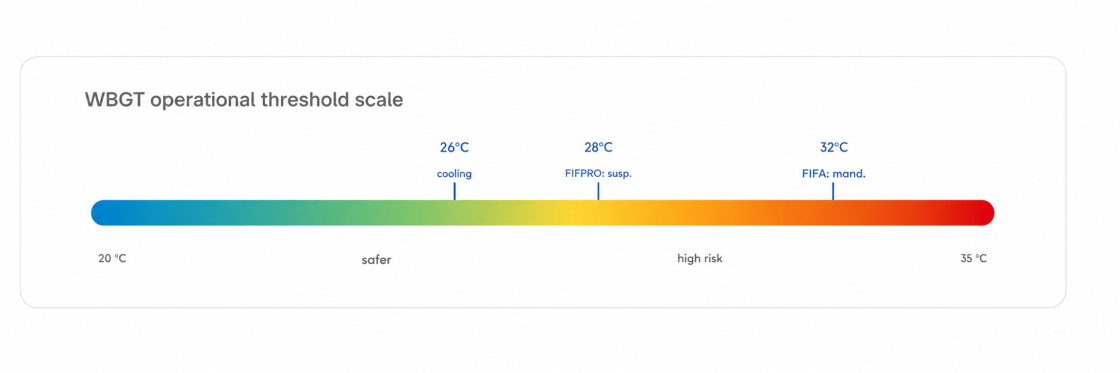
Heat stress is recognized as a medical risk, and WBGT is indicated as the reference index for assessing environmental risk.
FIFA
Italian Football Federation
32
°C WBGT
When the WBGT reaches or exceeds 32°C, the protocol provides for mandatory cooling breaks or the assessment of postponing/suspending the match.
FIFPRO
Italian Federation of Professional Footballers
26
°C
→
28
°C
More conservative thresholds: cooling breaks from 26°C WBGT and assessment of match postponement or suspension from 28°C WBGT.
ON THE FIELD
Why is WBGT better than air temperature alone?
Looking only at air temperature is reductive: on the field, other key variables come into play and can make two matches played at the same temperature feel very different.
In stadiums, the microclimate can vary significantly from one area to another: WBGT must be measured with suitable instruments, correctly positioned in the most critical areas of the field.
THE SCENARIO
Other sports are already adopting
more structured approaches
In diverse outdoor sports, protocols are already in place that use WBGT or other heat stress indices to define risk levels, mandatory breaks, and adjustments to competition formats, or even suspensions — in some cases, these rules are stricter than those used in football.
Tennis
Rugby
Football
Equestrian sports
Motorsport
Endurance
LSI LASTEM SOLUTIONS
Reliable real-time WBGT monitoring
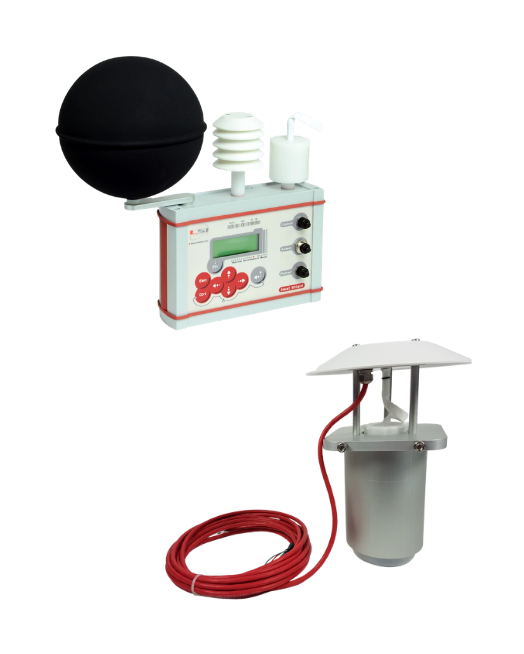
LSI LASTEM develops solutions for monitoring thermal stress in outdoor and indoor environments, with portable or fixed systems that calculate heat stress indices, including WBGT according to the ISO 7243 standard.
- Measures air, humidity, radiant and wet-bulb temperature
- Data transmitted in real time and viewable remotely
- Automatic alerts via SMS, email or electrical outputs
IN CONCLUSION
Heat cannot be managed only
with standard breaks or generic assessments.
Water breaks and cooling breaks are important, but when applied discretionally, they are not enough: objective, real-time and representative measurements of the actual conditions experienced on the field are needed.
That is why WBGT is essential.
Download the full report: WBGT and Sports Safety →
LSI LASTEM S.R.L. | C.F. e P.I. 04407090150 | Reg. delle Imprese di Milano n.1009921 © Copyright 2026
